
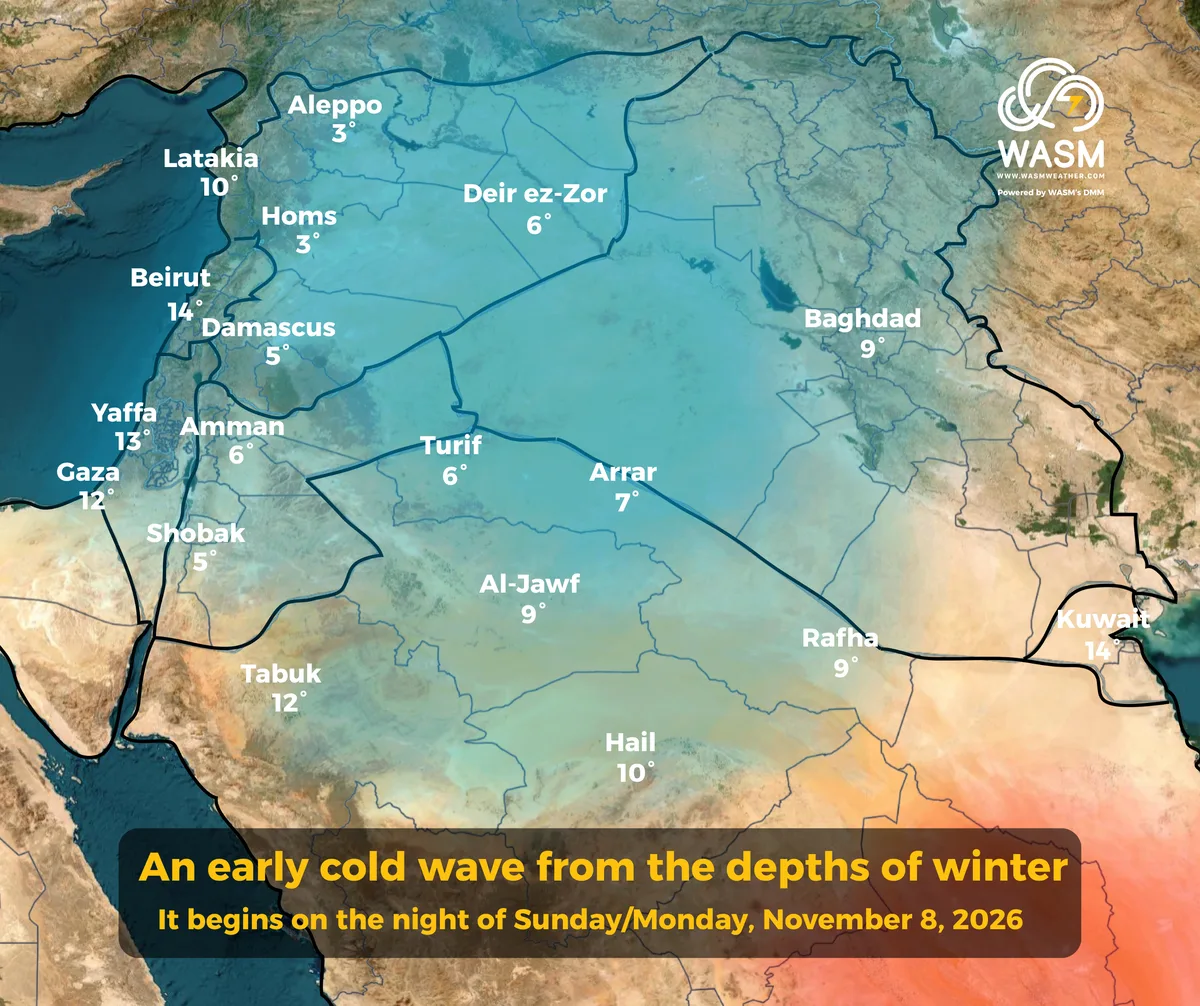
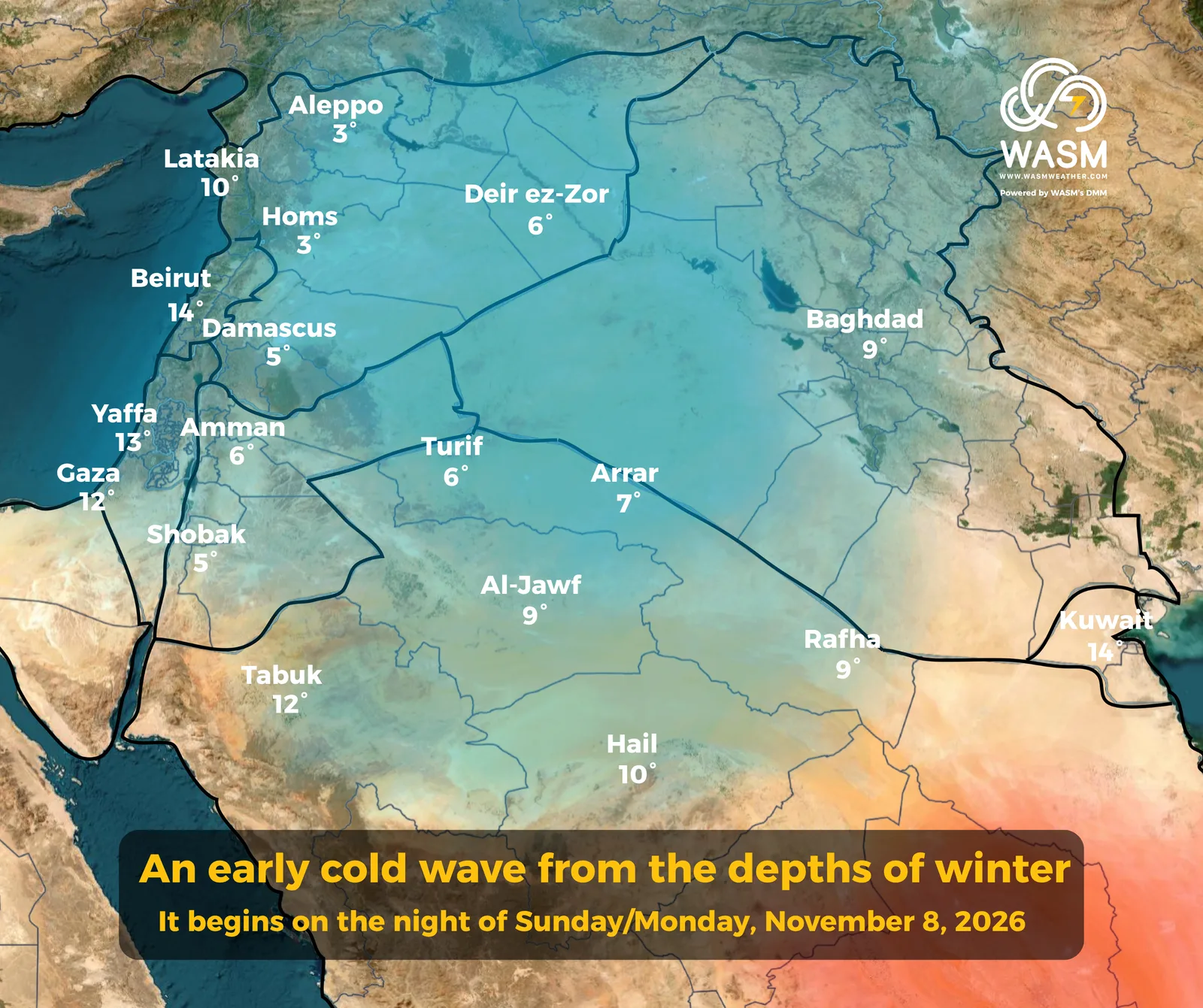
WASM – Northern Saudi Arabia, Iraq, and the Levant are expected to be affected by an unusually early cold wave with winter-like characteristics, leading to a noticeable drop in temperatures. Overnight temperatures are forecast to fall below 5°C across many mountainous and lowland areas during the coming nights.
Following the recent heavy rainfall event associated with a highly active low-pressure system, which triggered a regional wave of flash floods across Jordan, Syria, Lebanon, and Iraq, the remnants of a polar air mass previously located over Turkey and southeastern Europe are expected to surge into the region.
The early cold wave is expected to persist until dawn and the morning hours of Friday, after which it will gradually weaken, coinciding with a noticeable rise in temperatures.
At the same time, the axis of heavy rainfall is expected to shift toward central and eastern Saudi Arabia during the coming days, while the early cold wave continues to affect the northern Arabian Peninsula, the Levant, and Iraq.
New and Powerful Rainfall Events Ahead
The region is expected to be affected by a new series of strong and widespread rainfall events following the cold wave. These are anticipated later in the month after mid-November and during its final third, impacting the region on a broad scale.
We expect the strongest rainfall event of this exceptionally active autumn season to occur during that period.
Changes in the Behavior of the Polar Jet Stream
The early cold outbreaks are linked to changes in the behavior of the polar jet stream, a fast-moving air current located in the upper levels of the atmosphere.
According to WASM, these changes are associated with significant temperature shifts in the northern Atlantic Ocean region and have been monitored through research initiatives launched by the WASM Regional Center three years ago.
These atmospheric changes are expected to continue for several years and are projected to reach their peak between 2028 and 2030.
For more information and smart weather alerts, download the WASM Weather app:
iOS: WASM Weather on the App Store
Google Play: WASM Weather on Google Play