
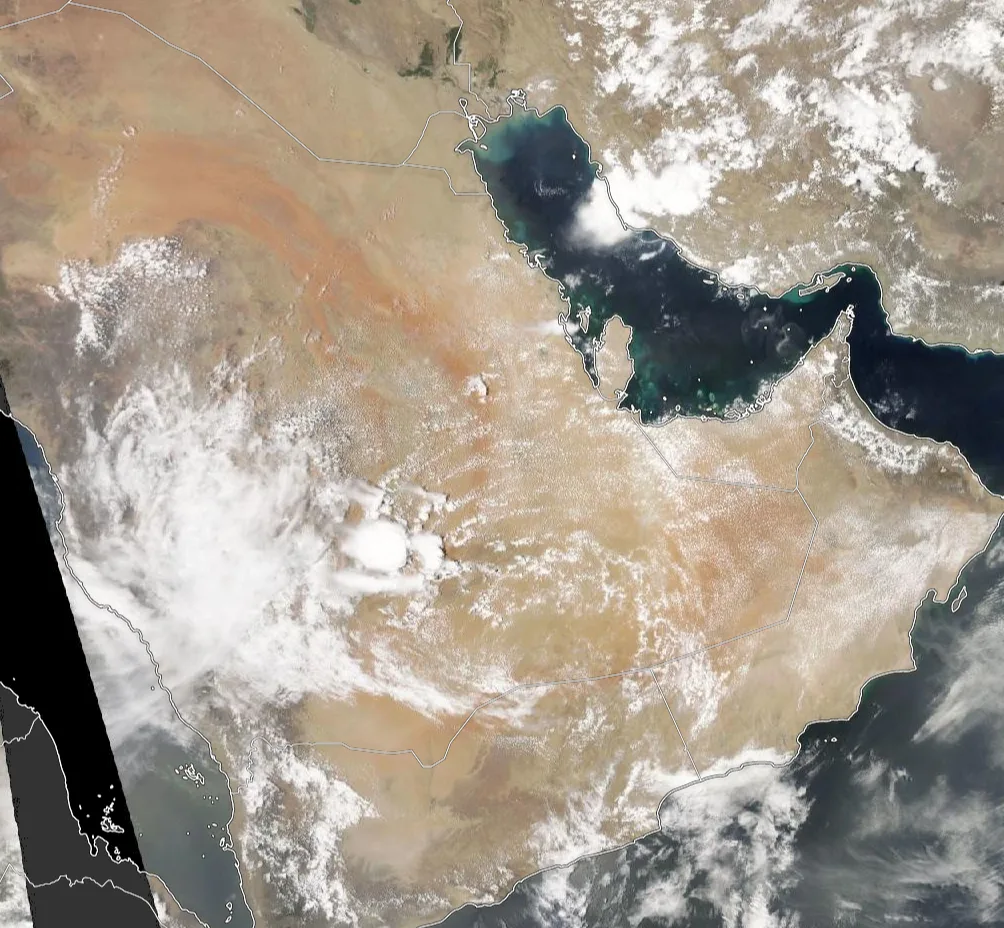
WASM – The Indian Monsoon Low is considered the "most important" thermal weather system in the Arabian Peninsula climate during summer, which has not received any significant studies in our regions, despite being a qualitative system that greatly affects long summer weather conditions in the Arabian Peninsula and fluctuations of heavy monsoon rains in southern Arabian Peninsula and Yemen during summer. It is the weather system causing the main tropical-subtropical circulation between India and the Arabian Peninsula and surrounding areas, where humid air currents rise via monsoon winds toward India, then descend and heat up and dry out over the Arabian Peninsula causing very high temperatures. This tropical-subtropical circulation is mainly caused by the Indian Monsoon Low.
With the issuance of a scientific report on "Dynamic activity synchronized with the Indian Monsoon Low," significant changes were observed in the axis of the Indian Monsoon Low over the past years and for approximately 25 years. The axis of this system shifted westward and northward more than usual and sharply, causing significant changes to the typical summer weather conditions in the Arabian Peninsula region compared to the usual summer situation.
The changes that occurred with the shift of the Indian Monsoon Low axis over recent years resulted in an increase in the rate of acute heat waves to more than double in the Levant region, according to a previous study issued by WASM in 2019, and a significant increase in rainfall rates in southern Arabian Peninsula. There was also a sharp decline and retreat in Shamal wind speeds, estimated at 4 km/hour below the usual seasonal condition, and a shift in the axis of these winds toward the west of Al-Hafar Al-Batin area and central Iraq, which is unusual. Despite the topographic conditions in the Arabian Peninsula supporting the "mechanical" activity of these winds over the Gulf Basin and eastern Iraq due to the westward shift of surface atmospheric pressure gradient rates, this caused an increase in "adiabatic" descent of winds behind Iran's mountains, and as a result of counterclockwise wind circulation around the Indian Monsoon Low.
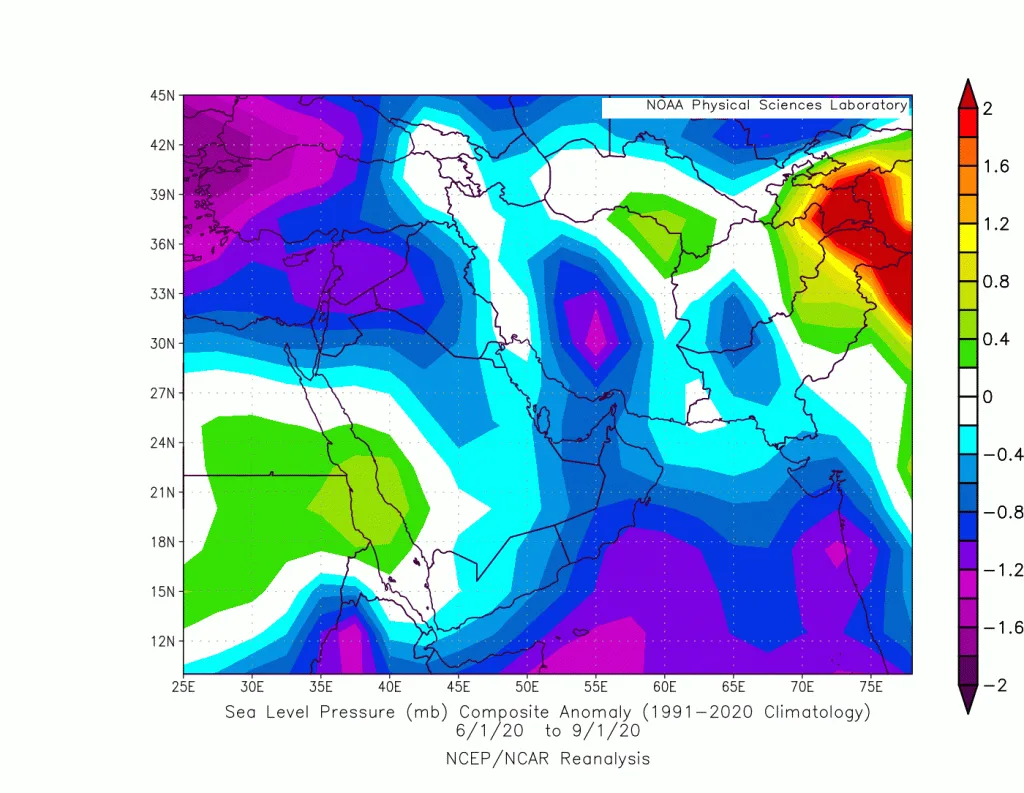
This caused an increase in heating over the Arabian Gulf Basin over recent years and an increase in the number of severe heat waves exceeding 52 degrees Celsius in both Kuwait and Iraq. This is because adiabatic wind descent behind Iran and Anatolian mountains, which previously acquired sensible heat energy from high condensation, increased temperatures in this basin (tropical-subtropical circulation between the Indian subcontinent and Arabian Peninsula during summer). Moreover, mixing between the hot surface layer and the frictional layer along with dust reduces temperatures slightly during the day, as this phenomenon weakened somewhat with the weakening and retreat of Shamal winds.
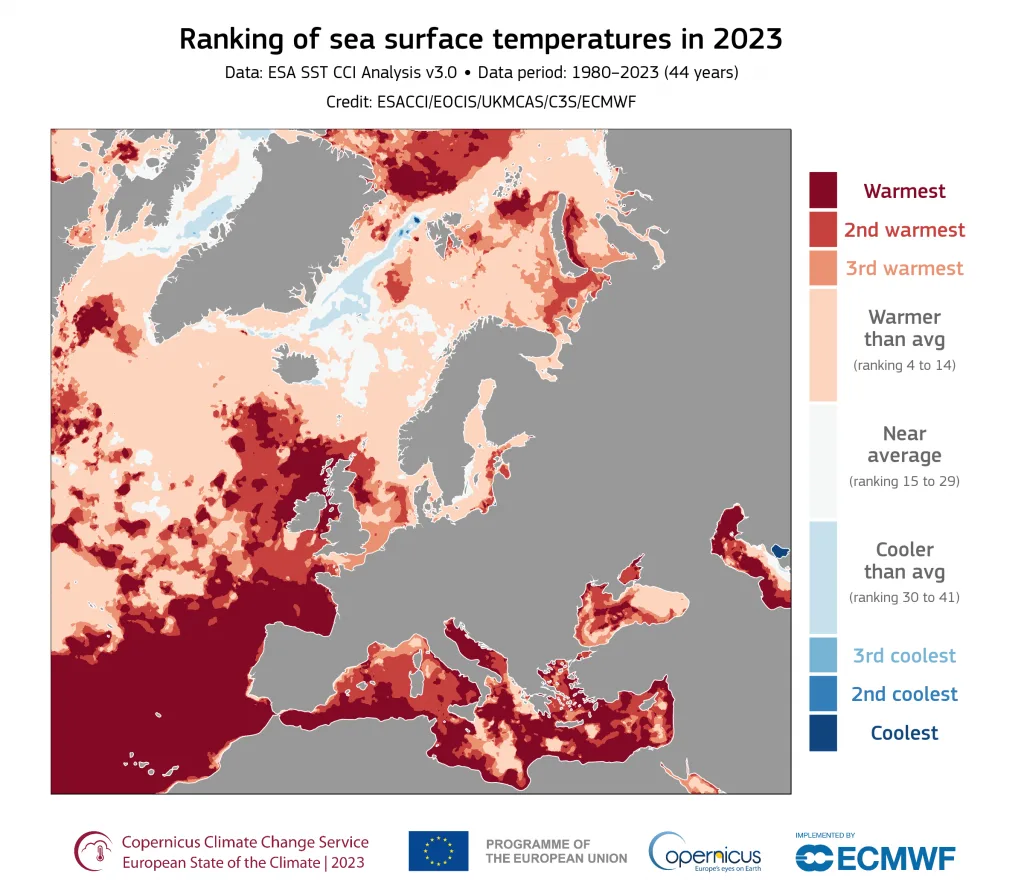
The scientific reasons studied by the WASM Regional Center were related to several points, most importantly the warming of the eastern Mediterranean Sea surface and the weakening and reduced extension of the Azores high-pressure system, as well as increased activity of adiabatic low pressure behind Cyprus island (lee low). These combined factors actually caused an important shift in the center of the Indian Monsoon Low and its severe impact on increasing rainfall rates in both the southwestern Saudi highlands and Oman during summer, and even the extension of heavy monsoon rains toward the interior regions of Saudi Arabia.
Westward shift of the Indian Monsoon Low center..
When studying MSLP and Anomaly maps and surface layer wind speed data since 2000, it was found that the Indian Monsoon Low center shifted westward clearly for the past 25 years, and began forming other centers benefiting from the topographic situation that causes adiabatic heat elevation, such as the Cyprus island area, and benefiting from the increasing eastern Mediterranean heat during recent years, which causes weakening in the extension of the Azores high-pressure system responsible for pushing the Monsoon Low toward the Arabian Gulf Basin and supporting the mechanics of dust-raising Shamal winds.
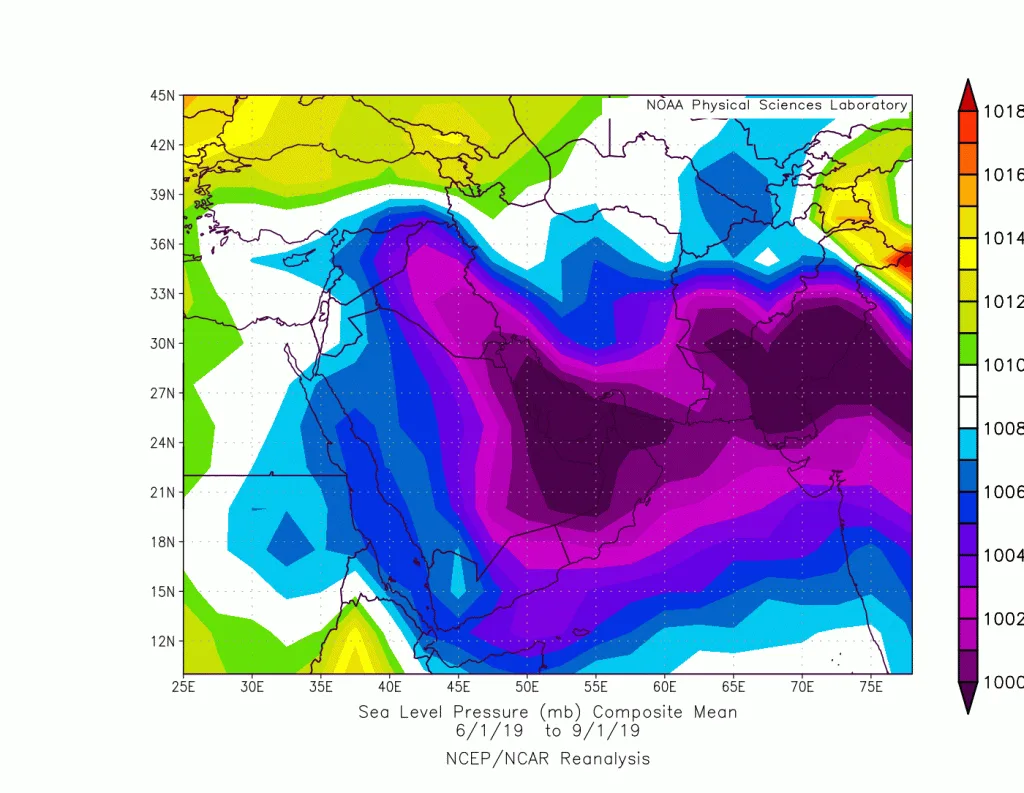
This shift caused a clear weakening and retreat of approximately 4 km/hour in longitudinal wind speeds, particularly over the Arabian Gulf Basin, but at the same time an increase over the Al-Hafar Al-Batin and central Iraq area, where a clear shift in atmospheric pressure gradient was observed toward those regions.
This resulted in several important matters: first, a retreat in summer dust waves in the Arabian Gulf Basin but an obvious and tangible increase in temperatures and intensification of heat waves. Shamal winds, which are hot and dust-raising, help reduce the intensity of solar radiation and mix air between the frictional and surface atmospheric layers despite the heat of these layers, or depending on their source of momentum, which may be from the northeast Mediterranean and which contributes to slightly reducing the heat.
The retreat in the intensity of surface atmospheric pressure gradient over eastern Iraq and Kuwait helped the winds resulting from adiabatic descent dominate the region, driven from behind the Anatolian mountains and heating the region significantly, which reflected on the severity of heat waves and increased their numbers in the Arabian Gulf Basin and even central Saudi Arabia and Iraq.
The results not only reflect this increasing and important atmospheric phenomenon over recent years, but reached the point of attracting monsoon winds toward the Indian Monsoon Low in southern Arabian Peninsula with its secondary center, and a clear increase in rainfall rates with increased frequency during summer. These weather conditions appeared clearly since summer 2015 specifically and reached their peak between 2018 and 2021.
Westward shift of Shamal wind activity..
As a result of this atmospheric organization of the Indian Monsoon Low, the axis of Shamal wind activity shifted westward toward the west of Al-Hafar Al-Batin and central and southern Iraq, with a clear retreat in longitudinal wind speeds, particularly over Kuwait, the Eastern Region, and eastern Iraq. This means the shift of the surface atmospheric pressure gradient zone toward the west.
The rate of Shamal wind speeds (longitudinal average) in Kuwait and eastern Iraq declined by approximately 4 km/hour over recent years, especially over the past 25 years according to reanalyzed data based on the Reanalysis system. At the same time, an increase in these wind speeds was observed but with less intensity over west Al-Hafar Al-Batin, which reflects the shift of the Indian Monsoon Low axis, where the mechanical factors supporting Shamal wind strength are absent in those areas, thus reflecting a retreat in dust levels during summer compared to previous years.
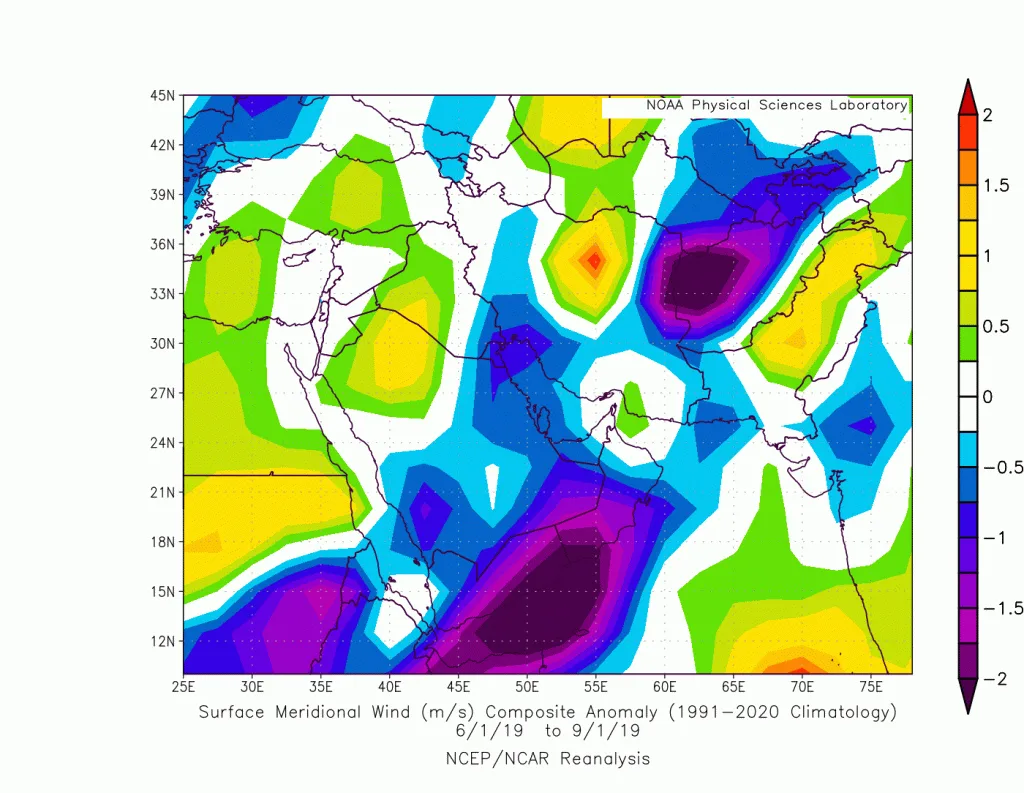
Weakening and declining Shamal wind speeds mean an obvious increase in temperatures and intensification of heat waves. The factors depending on increased adiabatic heating driven from behind the Anatolian mountains increase, thus causing intensification of heat waves, especially over Kuwait and Iraq, and placing great pressure on the electricity sector.
Intensity of heat waves toward the eastern Mediterranean, Turkey, and the Levant..
The westward shift of the Indian Monsoon Low center caused hot air masses to be pushed more than usual toward the Levant region, and increased the number of strong heat waves from one strong heat wave every 2-3 years to 1.5 strong heat waves per year, and doubled compared to the past. However, a clear retreat occurred since summer 2021 until this summer, with the reason being the increased adiabatic activity over Cyprus island, which will be explained in detail.
High rainfall rates in southern and western Saudi Arabia and Oman..
The positioning of the Indian Monsoon Low toward the center and west of the Empty Quarter area and the northern Saudi border region with its secondary centers caused an increase in the drive of monsoon winds toward southern and western Saudi Arabia and Oman, sometimes continuously, and even reached the extension of monsoon winds toward central Saudi Arabia, the Riyadh area, and the Eastern Region, and a wide range of northwestern Saudi Arabia. This helped push the Intertropical Convergence Zone (ITCZ) further north, causing a change in the rotational movement in the tropical-subtropical cell, which is the Hadley cell, and an increase in the chance of hot and dry air currents descending further north and toward the Levant, causing strong dynamic heat waves characterized by intensity and long duration, which extend even to Turkey and the entire Mediterranean Basin, such as those that occurred in August and September of summer 2020.
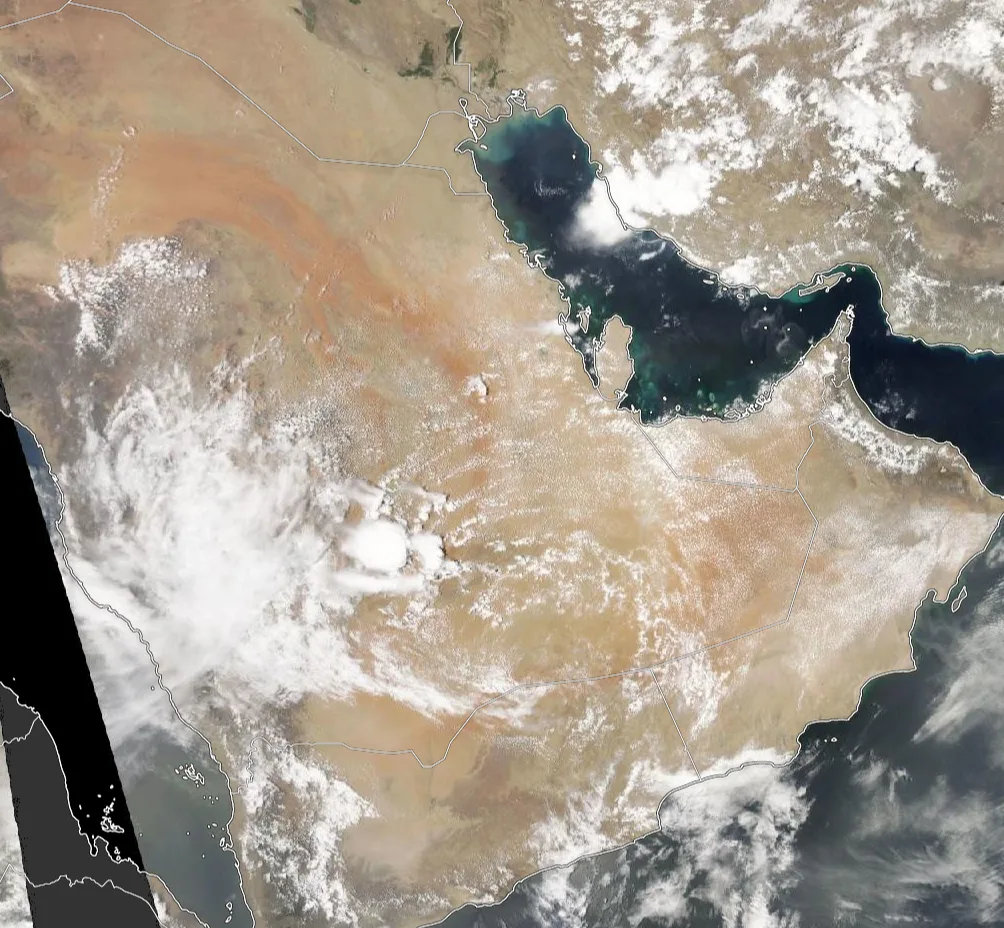
The impact of monsoon winds toward southern and central Arabian Peninsula caused the appearance of a new rainy season in areas that do not usually experience heavy summer rainfall, and intensification of seasonal rainfall cases toward southwestern Saudi Arabia.
Increasing tropical activity in the Arabian Sea region..
It is common that the reasons for tropical activity and the appearance of tropical storms with increasing frequency is due to the warming of water bodies. However, this reason alone is not sufficient if strong barotrophic instability activity is absent in critical areas for the formation of these dangerous weather systems.
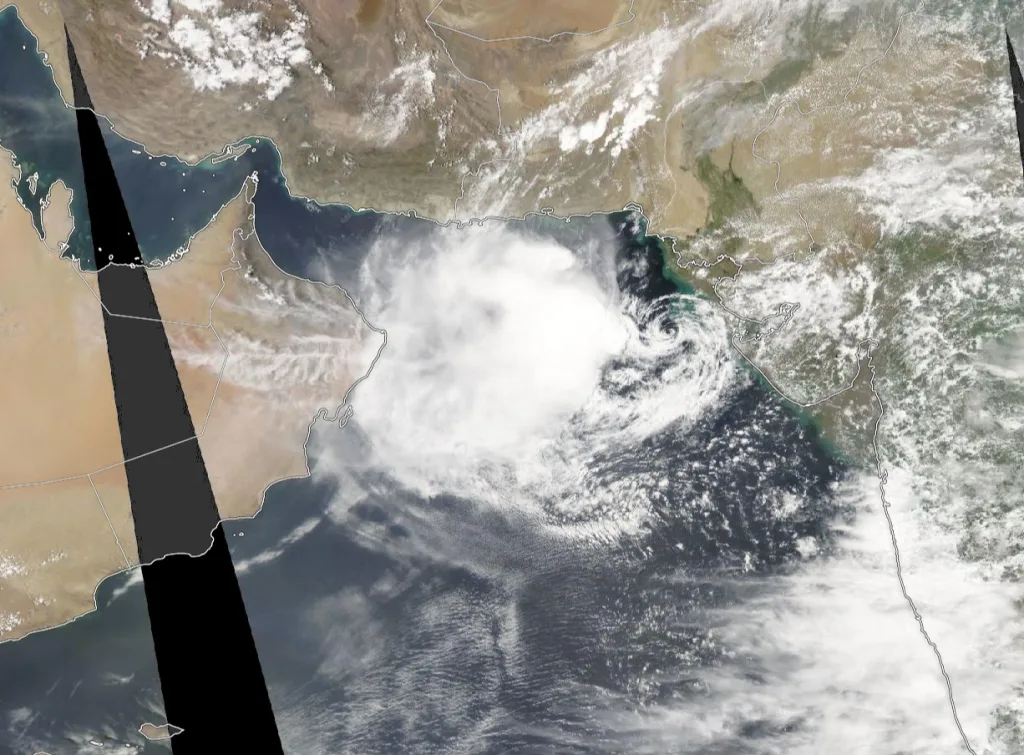
The westward shift of the Indian Monsoon Low caused a significant increase in the number of tropical waves driven toward the Arabian Sea region and an increase in tropical activity, which appears clearly at the end of summer seasons, and before the peak of monsoon wind speed activity that causes dispersion and spread of lower moisture eastward quickly before the start of tropical system activity.
The Indian Monsoon Low and its position axis cause weather conditions very different because of its synchronization with the activity of the main and most important tropical cell in atmospheric circulation during summer and in the region of monsoon wind activity, which plays a very significant role in organizing the atmosphere as a whole.
Scientific reasons for the westward shift of the Indian Monsoon Low center..
The scientific reasons are related to several factors including temperature rise in the Arabian Peninsula region, and other reasons related to atmospheric dynamics, and reasons related to the recurrence of major climate phenomena such as the El Niño phenomenon and warming of the western Indian Ocean region.
These reasons caused the Indian Monsoon Low center to be pushed further westward and important changes occurred to the typical summer weather conditions, which resulted in temperature rise and increased rainfall rates.
Atmospheric dynamics..
Due to the increase in the strong Atlantic storm index and as a result of warming in the northern Atlantic Ocean region, this caused strong heat waves to be pushed toward central and eastern Europe with increasing frequency compared to previous years. This resulted in rising atmospheric pressure over southeastern Europe and western Siberia and extending toward parts of Iran.
As a result of this changing atmospheric organization, the Indian Monsoon Low center was pushed westward more than usual toward central Saudi Arabia and Iraq and extending toward the eastern Mediterranean Basin.
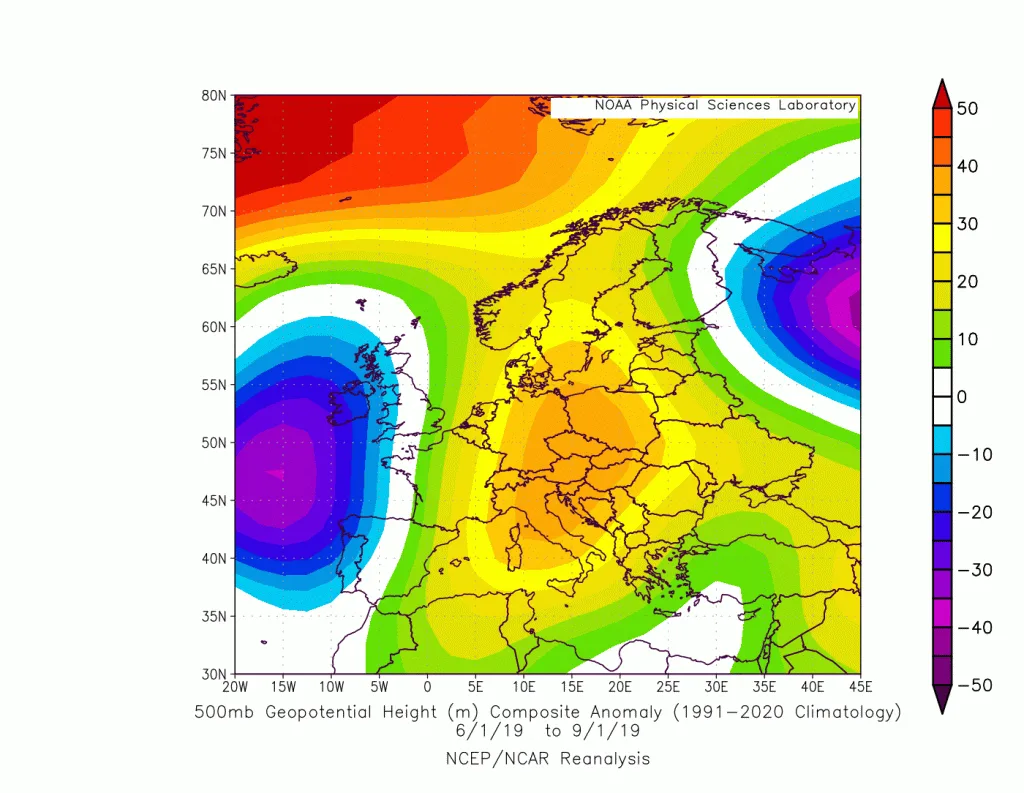
This changing atmospheric organization, which also coincided with an increase in the index and frequency of heat waves on the European continent at the same time, caused a change in the Indian Monsoon Low axis, which is affected by atmospheric circulation like any weather system due to natural atmospheric dynamics.
El Niño climate phenomenon and western Indian Ocean warming..
Studying these factors and reflecting them on the results will easily show the westward shift of the Indian Monsoon Low center easily during the end of these phenomena, especially with the activity of strong tropical waves toward the western Indian Ocean region, and increased intensity of northern Atlantic storms and even western Europe coinciding with El Niño years, which affect atmospheric dynamics as explained in the previous point. Increasing tropical activity increases the intensity of the tropical-subtropical circulation around the massive Indian Monsoon Low center area, and the intensity of the weather conditions synchronized with it.
During this increasing activity, a westward and northward shift of the Indian Monsoon Low center was observed more than usual, which increases the different summer weather conditions explained in this mini-study in the points above.
The El Niño climate phenomenon plays a very significant and major role in the tropical circulation of the atmosphere as a whole and increases the subtropical heating phenomenon due to tropical circulation activity in the equatorial Pacific region and again in the western and central Indian Ocean region. This shift is more noticeable at the end of El Niño years and during the beginning of summer, as well as at the end of summer with the beginning of El Niño phenomenon.
Eastern Mediterranean warming..
The Mediterranean is considered among the most important water bodies in the region and greatly affects the climate of the European continent, the Arabian Peninsula, the Levant, and North Africa, and as a result of baroclinic Mediterranean storm activity that plays a large role in thermal balance processes and weather conditions in those areas.
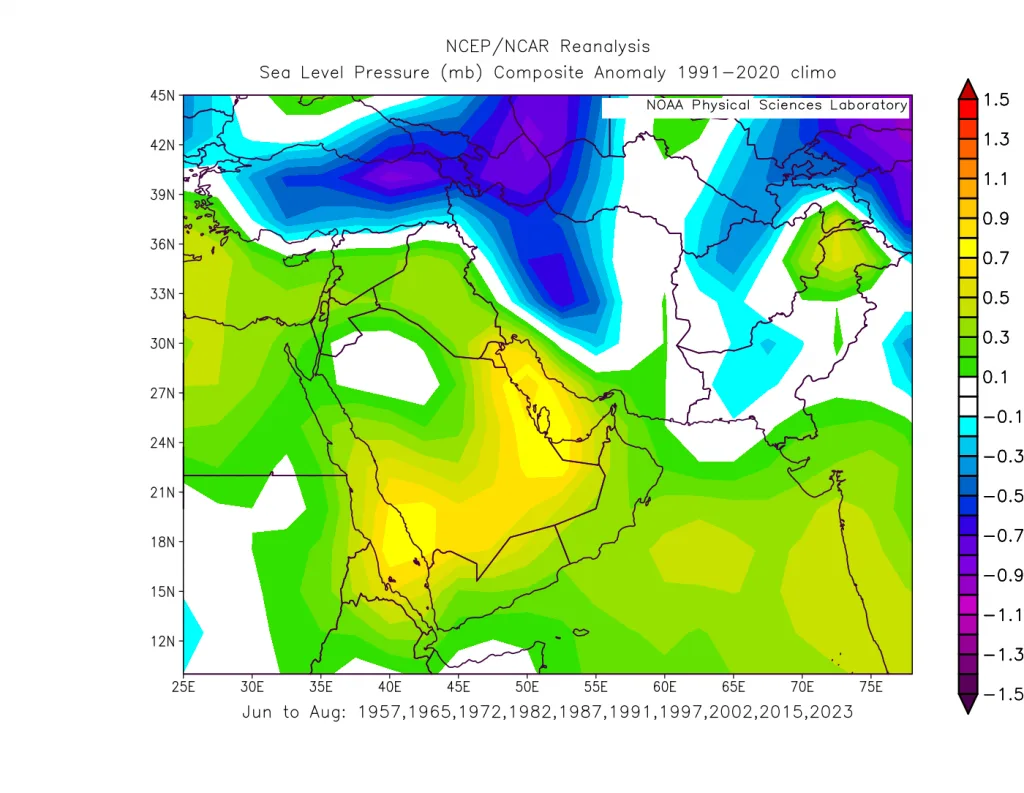
The warming of the Mediterranean caused a weakening in the extension of the Azores high-pressure system toward its eastern parts and activated low pressure resulting from adiabatic heat behind Turkey's mountains. This pressure decrease increased in recent years and helped the Indian system to extend and shift more westward.
However, the results and as a result of increased this activity, caused a slight rise in atmospheric pressure and increased intensity of surface atmospheric pressure gradient toward northern Egypt and even southern Levant region, as well as over northern Saudi Arabia and central Iraq (west of Al-Hafar Al-Batin), which is the area where Shamal wind activity shifted.
The continued increase in atmospheric pressure decrease over the Cyprus Basin during summer compared to previous years may reduce the intensity of heat wave pushing toward the eastern Mediterranean Basin due to increased westerly wind activity at a later time, and may be the reason for a clear decline in heat waves since summer 2021 compared to previous years.
Main points from the mini-study..
- The Indian Monsoon Low axis is driven westward and northward more than usual, moving the surface atmospheric pressure gradient zone to west of Al-Hafar Al-Batin.
- A clear retreat in Shamal wind longitudinal speed and partial shift of its activity westward toward Al-Hafar Al-Batin.
- Retreat in dust levels over Kuwait and eastern Iraq reflecting in high temperatures in those areas.
- Intensification of heat waves over Kuwait, eastern Iraq, and the Eastern Region, and increased heating over central Saudi Arabia.
- This resulted in a significant increase in energy demand in Kuwait and Iraq over recent years due to severe heat wave intensification.
- An increase in the number and intensity of heat waves in the Levant region and even eastern Mediterranean and Turkey.
- An increase in rainfall rates in southern and western Saudi Arabia and Oman and the appearance of a new rainy season in vast parts of Saudi Arabia's interior regions during summer.
- Increased tropical wave activity toward southern Saudi Arabia increasing the levels and number of hurricanes during the end of summer season or before its beginning.
Future forecasts..
With the addition of changes that will occur to the Indian Monsoon Low center westward and using our climate model at the WASM Regional Center, and coinciding with very high eastern Mediterranean warming, it is expected that this will cause important changes in the tropical-subtropical circulation between the Arabian Peninsula and tropical regions and India that occur at different atmospheric layers. This increases the chance of strong heat waves occurring toward Kuwait, Iraq, and eastern Saudi Arabia. However, at the same time, there will be a retreat in the intensity of summer heat waves in the Levant region due to sharp adiabatic pressure decrease over the Cyprus Basin and coinciding with intensifying heat waves toward Europe.
Shamal "longitudinal" wind activity will continue with slow retreat, and shift of its activity westward toward Al-Hafar Al-Batin compared to the seasonal situation.
Heavy unseasonable and summer rainfall will increase over a wide range of the Arabian Peninsula during the coming years and become more frequent, and may even reach parts of the Levant region with the intensification and extension of the Indian Monsoon Low toward wide areas.