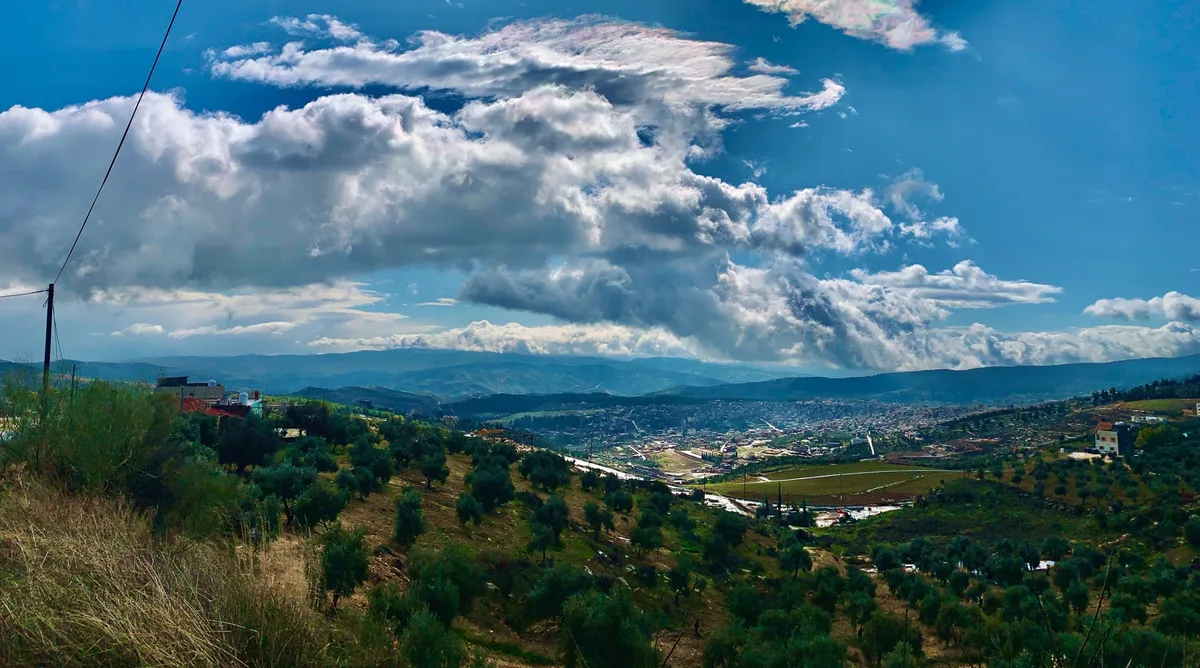
WASM- The Kingdom continues to experience typical to moderate summer weather at times, and it is expected that the country will be affected in an unusual and unseasonable manner, starting from the middle of next week, by a "moderate and humid" air mass that will continue for extended periods, resulting in temperatures dropping several degrees below seasonal averages.
The atmosphere in high mountains may be semi-autumnal at times, coinciding with moderate northwest wind activity, and temperatures are expected to be slightly cool during the night and early morning with the appearance of low cloud amounts.
Temperatures drop slightly at the end of this week with typical to moderate summer weather..
Temperatures will drop slightly during the end of this week, with temperatures within or slightly below their seasonal averages in high mountains and western regions of the Kingdom, which tend to be moderate in general, while remaining normally hot in the Dead Sea, Aqaba, and low-lying areas in a typical seasonal manner, and there is no truth to any reports indicating the Kingdom's exposure to hot air masses or heat waves, as normal seasonal temperatures have been recorded throughout the previous period to moderate at times.
Slight temperature rise at the beginning of next week..
Temperatures will rise slightly on Sunday and Monday and remain within their seasonal averages, with moderate weather most of the time, especially in the mountains, and hot during midday and afternoon periods, especially in low-lying areas, valleys, the Dead Sea, and Aqaba, with temperatures around 32 degrees Celsius in the capital and mountains during the day and 21 at night.
A moderate "long-lasting" air mass begins mid-next week..
The WASM Regional Center is monitoring a humid and moderate air mass with long-lasting effects that begins mid-next week and continues for an extended period, which is expected to push from the north of the Atlantic Ocean, passing through northern Europe and in an unusual manner, arriving as a moderate air mass towards the region. This air mass causes temperatures to drop several degrees below their seasonal averages amid semi-autumnal conditions in high mountains and the presence of low cloud amounts and moderate northwest wind activity.
According to climate records, seasonal temperature averages in the capital, Amman, rise to their highest levels during this period, especially at the end of July and beginning of August, reaching around 33-34 degrees Celsius, but it is expected that the opposite will occur this summer in an unusual manner.
The reason for the impact of this moderate air mass is due to the push of a strong heat wave toward the North Pole from Canadian territories, causing a sharp oscillation in the polar jet stream over the Atlantic Ocean region, and pushing a cold air mass toward northern and eastern Europe, then arriving as a moderate air mass toward the central and eastern Mediterranean, the Levant, Jordan, northern Saudi Arabia, and Egypt.
At the same time, it is expected that wide areas of western, southwestern, and central Europe will be affected by strong and intense heat waves with the end of July and beginning of August, which increases the persistence of moderate conditions over the region.
Away from the unprecedented media exaggeration regarding summer temperatures in the Kingdom, which began in the previous summer, the Kingdom experienced relative moderation in conditions during July contrary to what occurred in June, and after reviewing precise weather data from the WASM team, we found that Jordan recorded temperatures higher than their seasonal averages by about 3 degrees Celsius during June, which classifies it as a hot summer month and not a record-breaking one, unlike global temperatures which witnessed record figures, and climate change does not mean only temperature rise, but rather a set of new climatic factors for the region such as high precipitation rates and intense storms during rainy seasons or the intensity of cold or heat waves that may occur.
Jordan | Moderate air mass with "prolonged effect" begins mid-next week