
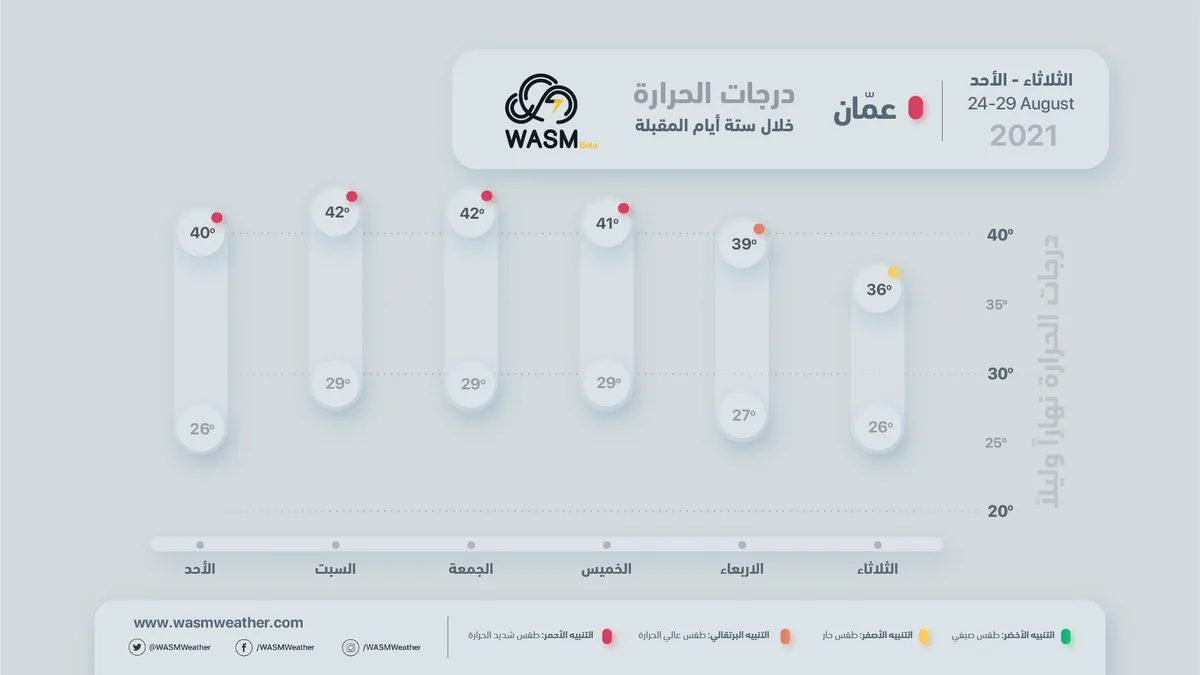
WASM- A strong heat wave will resume over Jordan tomorrow, Tuesday, gradually, following its temporary easing on Monday. Temperatures will rise to "significant" levels during the coming days, especially on Wednesday, Thursday, Friday, Saturday, and Sunday at least. This comes after the capital Amman recorded 39°C last Saturday, which WASM Regional Center accurately predicted.
Tomorrow, Tuesday, as the heat wave surge from the south and east resumes toward Jordan, temperatures will record 35-36°C with a decline in wind speed, then will increase significantly on Wednesday and approach 40°C, to exceed the 40°C threshold starting Thursday and for several consecutive days.
According to the forecast model, which relies on W.DMM technology developed by WASM Regional Center, the capital Amman is expected to record 42°C, particularly next Saturday, coinciding with the peak of the strong heat wave affecting the Kingdom.
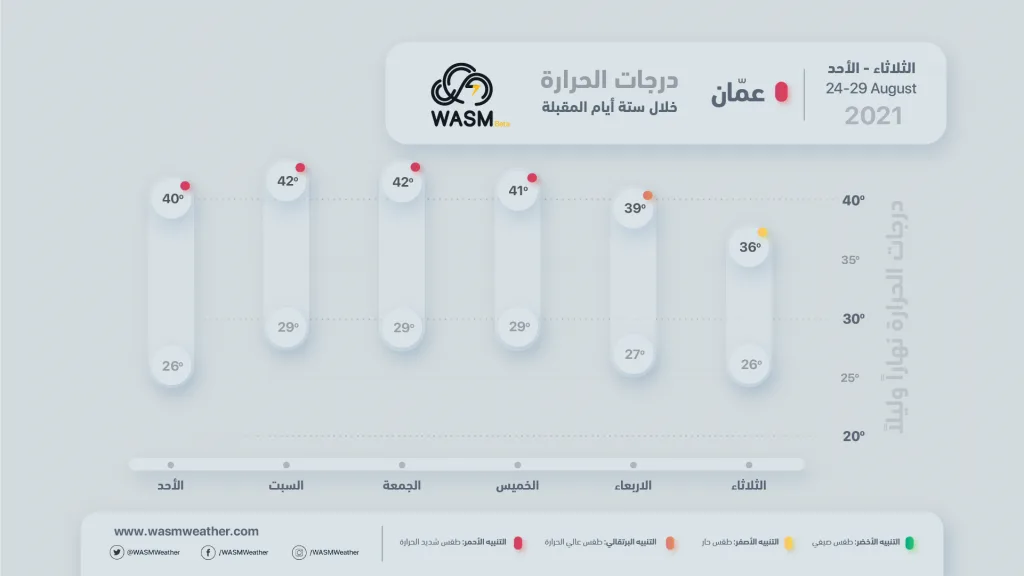
It is expected that the intensity of the heat wave will ease "slightly" without a clear sensation of relief at the beginning of next week for a temporary period, before intensifying mid-week, which is expected to reach its peak intensity, then gradually recede during the end of the first week of September.
Jordan is being affected this summer by "successive" heat waves, which began early, since the end of spring until the present time, in extension of strong global heat waves that have caused significant ice melting in the Arctic region, major forest fires around the world, and rising temperatures in oceans and seas.
Regarding temperatures in the governorates, it is expected to reach 40°C in the city of Irbid at the end of the week, especially Friday and Saturday, and 45°C in Zarqa, exceeding 46°C in both the Dead Sea, Jordan Valley, and Aqaba, especially mid to end of next week. The high mountains of the capital Amman, Salt, and Ajloun are expected to record temperatures exceeding 37°C, but high humidity levels in those areas will make the temperature feel extremely high.
WASM advises staying away from direct sunlight, consuming plenty of cold fluids, and following warnings from the Jordanian Meteorological Department. It also recommends not leaving sterilization materials inside vehicles and being cautious about plants drying out due to the intensity of the heat wave.
The cause of the "strong" heat wave is due to the extension of the Red Sea low-pressure system from the south, which will push very hot winds toward Jordan directly. The strong heat wave will affect Palestine, the Levant, eastern Egypt, Turkey, northern Saudi Arabia, Iraq, and later all Mediterranean regions and southern Europe, making it the most intense heat wave of this summer for the region.