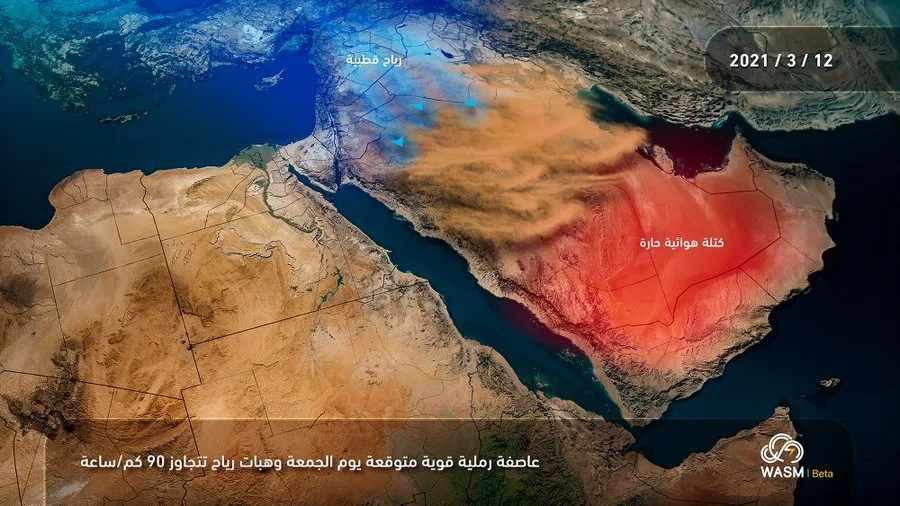
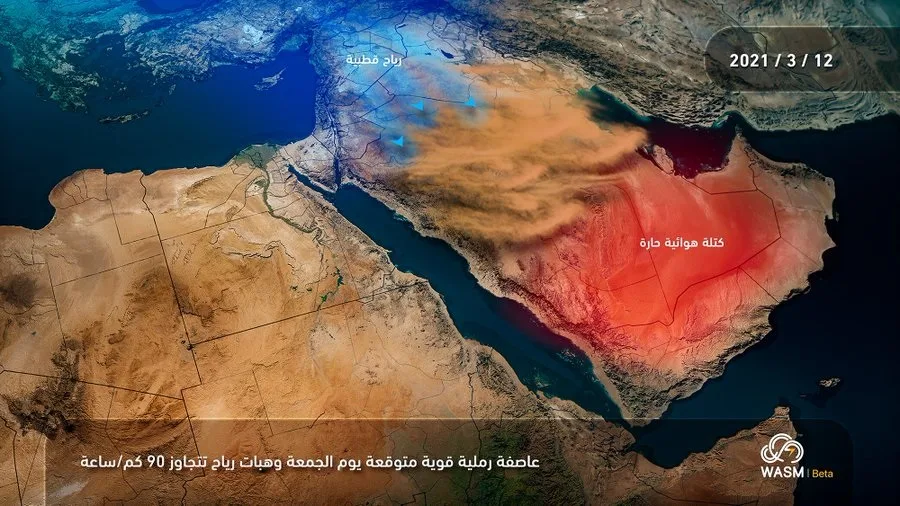
WASM — Saudi Arabia and the Arab Gulf states are expected to be affected by a "strong" dust storm on Friday, causing a complete loss of horizontal visibility and "stormy" wind gusts reaching 90 km/h and sometimes exceeding that, affecting vast areas extending to the Arab Gulf states. It will also result in a "significant" drop in temperatures exceeding 20 degrees Celsius.
The strong dust storm will begin during the morning hours across most regions of the Kingdom, including Riyadh, Qassim, east of Madinah region, the Northern Borders, Al-Jouf, Hail, Hafar Al-Batin, and the Eastern region, as a result of "hot" dusty winds with gusts reaching 70 km/h coinciding with the advance of a cold air front accompanied by wind gusts exceeding 90 km/h coming from the north of the Arabian Peninsula, considered a "polar-origin" air front.
The "strong" dust storm will intensify coinciding with the advance of the cold air front towards various regions of the Kingdom during the day, leading to a complete loss of horizontal visibility coinciding with stormy gusts, which is the peak impact of the strong dust storm on the region. The strong dust storm will move during the dawn of Saturday towards southern Saudi Arabia, the UAE, and the Sultanate of Oman, affecting Najran and Jazan and their surroundings during Saturday, and will gradually extend towards Yemen after Saturday afternoon.
The strong dust storm is expected to include Kuwait, Iraq, Qatar, and Bahrain, particularly during Friday evening, leading to severe sea disturbance and high waves. However, the Red Sea coasts, including Jeddah and the Holy Capital, are not expected to be affected by the dust storm.
The WASM Regional Center has issued a red alert level for the strong dust storm on Friday, which is expected to significantly and noticeably affect land, air, and maritime navigation. WASM advises against traveling outside for trips and "outings" on Friday. Residents of the Arab Gulf coasts are also not advised to go to the sea due to expected severe sea disturbance and high waves. WASM advises closing windows and doors well to prevent dust from entering homes and indoor spaces.
The strong dust storm will recede from most regions on Saturday, except for the southern regions that will be affected by the strong dust storm, particularly Najran, Jazan, south of Riyadh region, the UAE, and the Sultanate of Oman, and later Yemen.
The strong dust storm is caused by the formation of two deep depressions, with the first positioned in the center of the eastern coast of Saudi Arabia, and the other positioned over northern Syria and Iraq accompanied by polar winds, causing a large temperature difference exceeding 20 degrees Celsius, which resulted from a significant difference in surface atmospheric pressure values. The first atmospheric depression positioned over the Arab Gulf coasts pushes extremely hot winds coming from the south of the Arabian Peninsula, while the second depression pushes extremely cold polar winds coming from Siberian regions, leading to strong wind activity. The vertical descending and ascending wind movements that coincide with the entry of the cold polar front also cause a thick layer of dust to be raised towards the upper atmospheric layers, which results in a complete loss of both horizontal and vertical visibility across vast areas.