
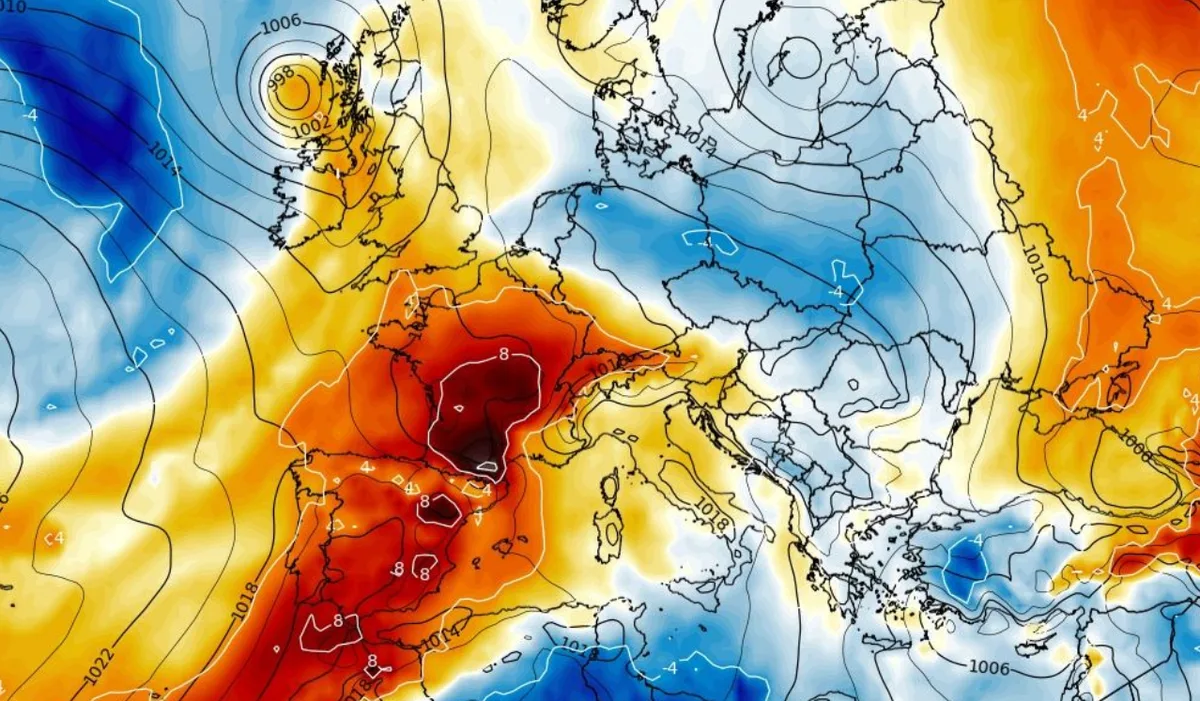
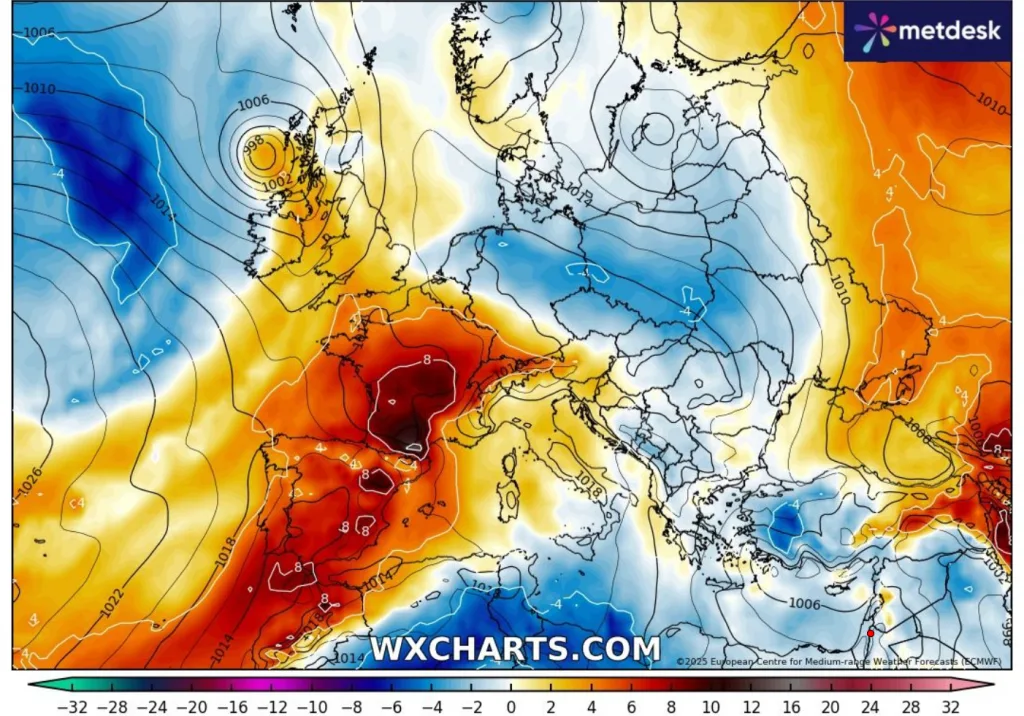
WASM- The WASM Regional Center continuously monitors new powerful heat waves moving toward Europe, which will concentrate mainly in its western and southwestern regions and parts of its central areas, extending to its northern regions and edges of the Arctic, due to highly extreme atmospheric circulation.
In terms of initial data, the heat wave will begin on the European continent starting from the southwestern regions in the middle of next week, then extend to the rest of its regions, which is expected to coincide with extremely high temperature values and may perhaps reach unprecedented levels.
Results for the Arab Region|
Mild weather or temperatures lower than usual will affect a wide range of northeastern Africa, northwestern Arabian Peninsula, the Levant, and Jordan. It is expected that parts of these regions will experience moderate summer waves that are "unusual," concentrating mainly during the first third of August and also during the second half of it, with some hot periods resulting from atmospheric circulation or the renewal of heat waves toward Europe.
Increasing rainfall rates, especially in the highlands of Jazan, Asir, and Yemen, as well as in Sudan. It is not ruled out that rainfall will extend to wide areas of the Sahara, specifically the deserts of Libya and Algeria and the Moroccan-Algerian border areas.
Despite the expected rise in temperature during some periods, especially during the second week of August in the Levant region, northwestern Saudi Arabia, and western Iraq, it will be characterized by short, varying, and non-comprehensive periods, with the exception of Moroccan regions and western Algeria, which may be exposed to successive heat waves during the coming period.
Analysis of Heat Wave Source|
Intense tropical activity was observed in the western tropical and subtropical African region (above 10 degrees north) extending from June 1 to July 26, with doubled activity recorded in the same areas during recent days, leading to clear and tangible secondary results regarding accumulation of hot and descending winds on the subtropical Atlantic range, offset by weak tropical activity in the Atlantic region due to cold waters.
This coincides with a severe weakening of the subtropical jet stream, which increases the flow of hot winds rapidly toward Western Europe without strong resistance. Tropical activity has become disturbed and intense in the northwestern interior northern tropical and subtropical African regions as a result of severe cold in the tropical part of the Atlantic Ocean, leading to the activation of barotropic instability within African tropical regions. Perhaps these cold waters appeared due to significant melting of ice in the northern part of the Atlantic Ocean.
The continuation of this type of heat wave may reinforce this circulation more powerfully, meaning intensification of these waves and these climate changes over the next 5 years.
The Mediterranean Still Hot|
The Mediterranean, especially its western part, suffers from elevated temperatures exceeding its typical seasonal averages by a noticeable amount of over 5 degrees Celsius. This leads to promoting these heat waves toward Western Europe and their continuation during the coming period. The WASM Regional Center issued a very important study on the warming of the western Mediterranean and its connection to drought and heat waves in Western Europe as well as wide areas of the Arab Maghreb.