
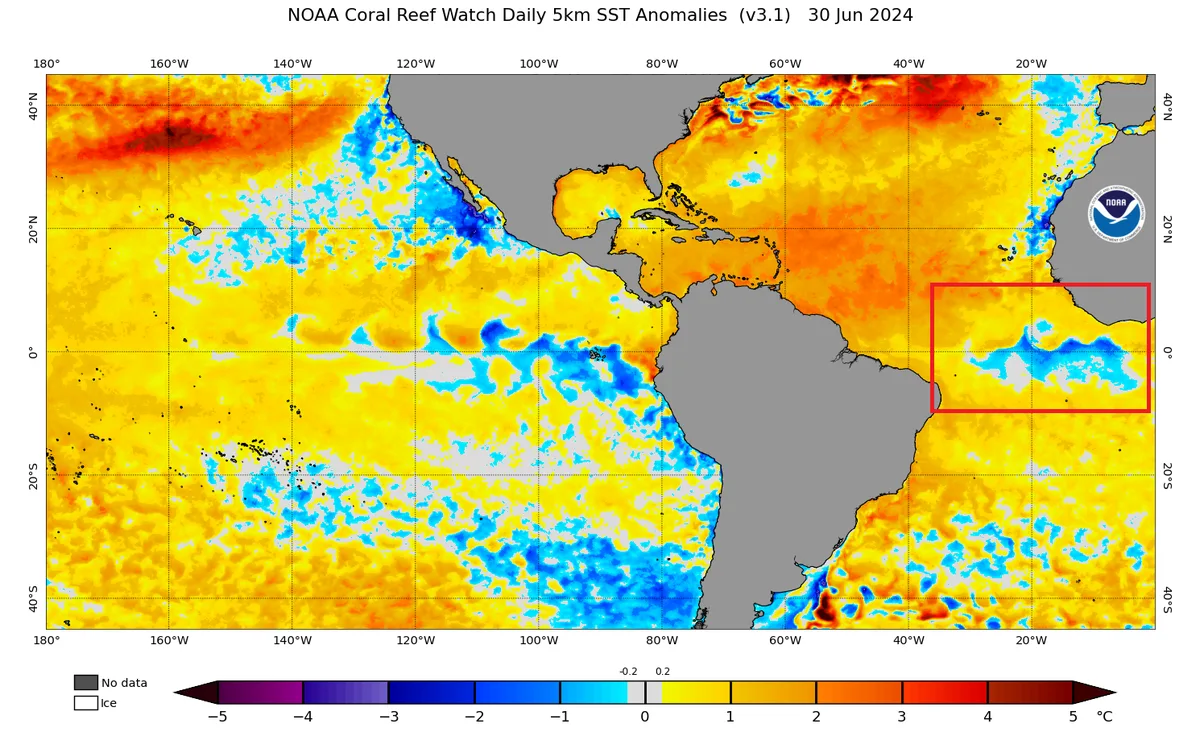
WASM – Temperature readings in the tropical region of the Atlantic Ocean are showing continuous and sustained decline compared to the previous period, which causes direct impact on the circulation of tropical and subtropical cells in the Atlantic Ocean region and its surroundings, and direct impact on the shape of the Azores high pressure system (or Bermuda high), with significant changes in weather patterns during the coming period.
Temperature decline near the coasts of northwest Africa and the tropical Atlantic region..
The temperature decline in those areas has been linked to the reflection of this effect on the shape of the Azores high pressure system, which is concentrated more towards Europe and takes the "North-South" shape. The increase in cold water in those tropical and subtropical regions could lead to further expansion of this high pressure system towards various European regions, specifically Western Europe.
On the other hand, the weakness of this tropical cell has a significant impact on atmospheric circulation in the North Atlantic, which was caused by the coldness of tropical and subtropical waters in the Atlantic region and coinciding with the expected intensification of tropical atmospheric conditions over the Amazon later, especially with the collapse of the El Niño phenomenon and the beginning of a slightly cool neutral state in the tropical region of the Pacific Ocean. This leads to a change in weather patterns over the North Atlantic to make Atlantic storms more directed towards south Greenland, and the polar and subtropical jet stream more curved towards the south.
This also causes significant weakness in the polar jet stream over Eastern Europe, and this will be noticed clearly during late summer. These complex circulations and unexpected climate factors will again cause significant weather conditions in the Eastern and Central Mediterranean and as well as wide areas of the Arabian Peninsula.
The coincidence of this with a significant rise in Atlantic Ocean water temperatures strengthens Atlantic storms, especially in the southern part of Greenland, which enhances the intensity of hot air surge towards Europe.
Strong heat waves towards Europe and severe weather disturbances..
This will result in the movement of hot air masses from the great African deserts towards the European continent, especially central and later western regions during the second half of July, and the impact of heat waves towards Europe may be severe and unusually extreme. It is known that heat waves and hot conditions towards Europe greatly increase the rate of floods and strong torrents as a result of rising temperatures and increased barotropic instability factors alongside the impact of sharp cold air fronts of the Kata type advancing from the North Atlantic, which are considered extremely dangerous at this time.
African desert hot masses will advance easily towards Europe, especially with the sharp drop in surface atmospheric pressure over southwestern Europe and west of the British Isles, which will be reinforced by the clear and sudden drop in temperature in the tropical Atlantic Ocean region.
Climate changes..
Climate changes do not necessarily mean only temperature rise, but rather they are very complex interlocking factors. For the Arab region, these climate changes have caused a very significant increase in rainfall rates reaching between 40-60% and an increase in temperature rates to about one and a half degrees Celsius, knowing that the strongest heat waves in the Arabian Peninsula, Jordan, and the Levant occurred between 2015 and 2021.
Impact on the coming rainy season..
According to the results, which are clear, the presence of a strong high pressure system over Europe most of the time will promote the continuity of cold wind surge towards the Eastern and Central Mediterranean and even northern Arabian Peninsula, and the continuation of strong rainy seasons in the region. The difference that will occur is colder temperatures during the coming season compared to the previous season as a result of changes in the path and direction of the polar jet stream.
There is no truth to the information being published which speaks about a decrease in rainfall rates in Jordan and the Arabian Peninsula in recent years, knowing that the Middle East region, Jordan, Saudi Arabia, and Kuwait were affected by the strongest rainy seasons in recent climate records during recent years with the extension of rainy seasons for unusually long periods.