
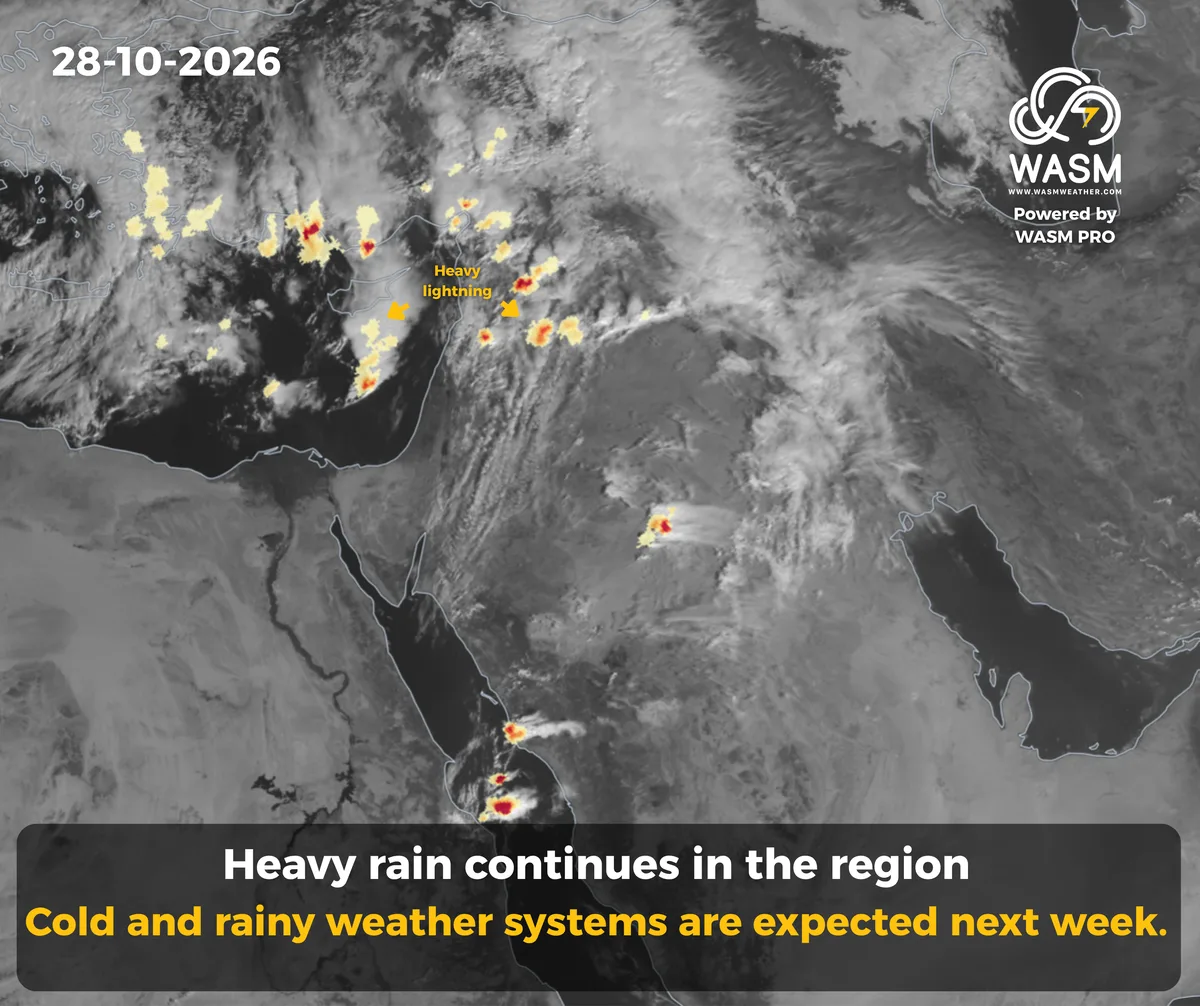
WASM – The rainfall event continues in the form of successive heavy rainfall waves and will persist through the first half of November. Cold, winter‑like low‑pressure systems are expected in the middle and end of next week, followed by even stronger and more widespread waves during the second week of November.
- Cold, winter‑like, and heavily rainy low‑pressure systems will affect the Levant, Iraq, northern Saudi Arabia, and Kuwait during the second half of next week due to the rare early approach of polar winds toward the eastern Mediterranean.
- A second, deeper and more humid equatorial wave is being monitored for the second week of November, expected to bring additional heavy rainfall to the region, especially the Arabian Peninsula and Gulf countries.
- Record‑breaking rainfall amounts are expected in parts of Iraq and Syria during the coming period due to heavy rainfall and successive waves.
- The climate model of the WASM Regional Center continues to detect the onset of heavy rainfall events with exceptional accuracy, outperforming all local and global sources.
The detailed seasonal weather bulletin for the Arab region for 2026–2027 has been issued.
Regional Rainfall Event Details
The rainfall event intensifies over wide areas of western and northern Saudi Arabia, the Hail region, Al‑Qassim, Al‑Jawf, and parts of the Northern Borders, and continues over the Levant—especially Syria, Lebanon, and northern Palestine—over the coming days.
The rainfall event will primarily focus on the Levant, Iraq, and northern and western Saudi Arabia, later extending toward Kuwait, Hafar Al‑Batin, and parts of central Saudi Arabia. Additional rainfall events are expected to affect central and eastern Saudi Arabia during the second week of November (details soon).
Flash‑Flood Risks
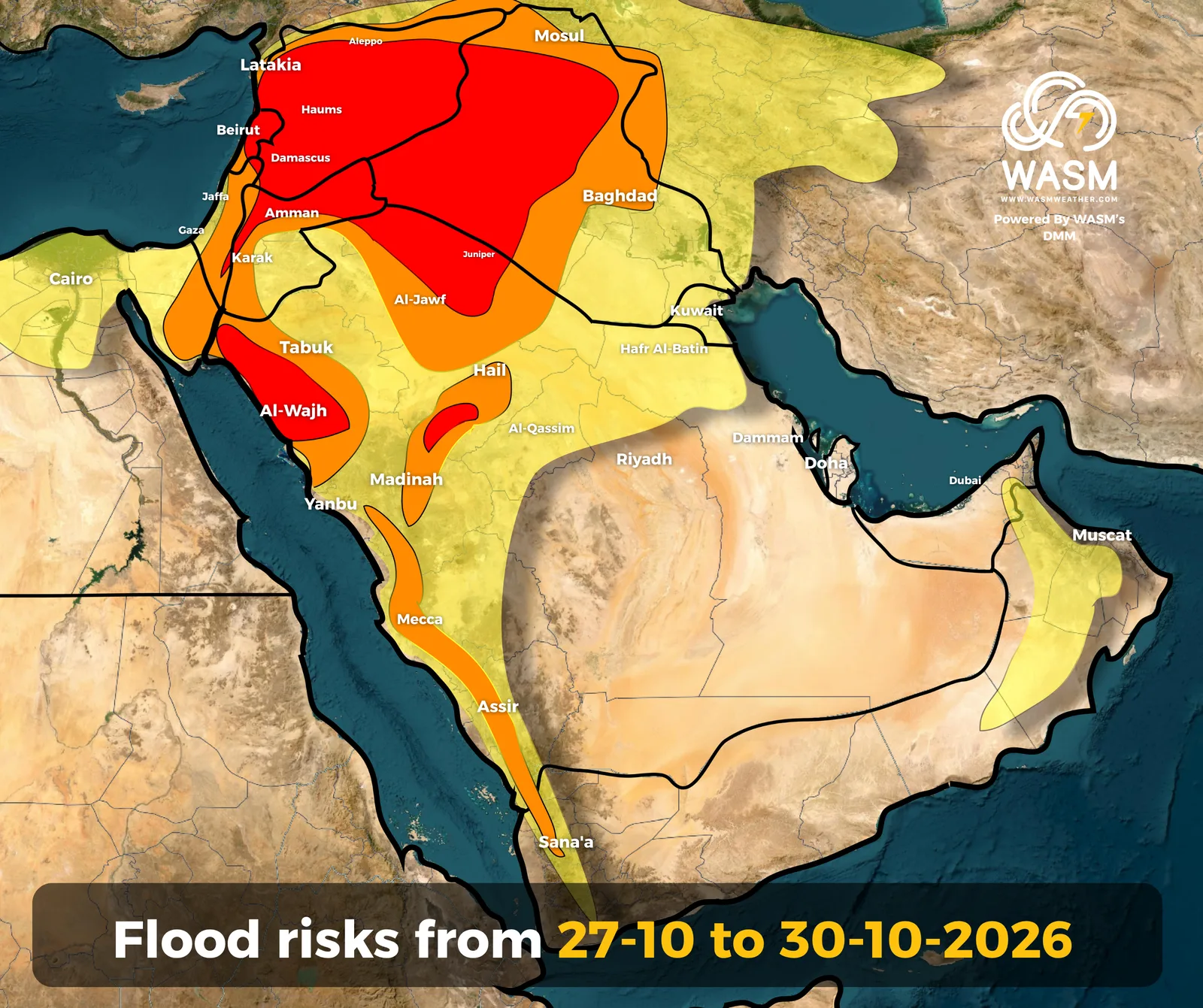
The WASM Regional Center continues to monitor the regional rainfall event, which is currently causing a regional flash‑flood wave across wide areas of western and northern Arabia, Saudi Arabia, the Levant, Iraq, and northern Egypt. The event will persist until early November, with record rainfall amounts expected in parts of Syria and Iraq. More details will be issued progressively.
Country‑by‑Country DetailsSaudi Arabia, Arabian Gulf, and Arabian Peninsula
The regional rainfall event intensifies over northwestern Saudi Arabia, Iraq, parts of the Levant, and surrounding regions, and continues through early next week.
Thunderstorm rainfall will affect Hail, northwestern Al‑Qassim, northwestern Riyadh, the Northern Borders, Al‑Jawf, and Al‑Madinah.
The rainfall event becomes severely heavy intermittently through Saturday, affecting Tabuk, Al‑Madinah, Hail, Al‑Qassim, Makkah, all regions of the Northern Borders, Al‑Jawf, and Iraq. It then extends toward Hafar Al‑Batin and later Kuwait by the end of the week, lasting for several days, with high flash‑flood risks.
The event affects the coasts of Al‑Madinah over the next two days, and parts of the Makkah coast on Thursday.
Heavy thunderstorm showers occur at times over the highlands of Makkah, Taif, Al‑Baha, Jazan, Asir, and surrounding areas.
Thunderstorm rainfall may extend into northern Riyadh and parts of the northern Eastern Province later in the week.
Heavy rainfall is expected to cover wide areas of Saudi Arabia and the Gulf region during the second week of November.
The Levant
Heavy rainfall continues especially over Syria, Lebanon, and northern Palestine, while temporarily decreasing over Jordan in the coming days.
Large and record rainfall amounts are expected over parts of Syria—especially northern and northwestern regions—due to the influence of a deep low‑pressure system.
Weather instability returns early next week, followed by several cold, winter‑like, and heavily rainy low‑pressure systems during the second half of next week, with the regional rainfall event continuing.
Jordan
The regional rainfall event temporarily weakens, with chances of scattered showers Thursday and Friday over parts of northern and central Jordan.
Weather instability returns early next week, with thunderstorm showers over northern, central, and eastern regions.
Jordan will be affected by cold, heavily rainy winter systems starting the second half of next week, with the regional heavy rainfall event continuing.
Heavy rainfall persists intermittently until the first half of November under cold, winter‑like conditions, with no significant breaks or stable periods expected during the coming month.
Syria
The heavy regional rainfall event continues for a long period—until the first half of November—under cold, winter‑like conditions.
Northern and northwestern Syria will be affected by a deep low‑pressure system at the end of the week, producing heavy rainfall with high flash‑flood risks.
Several regions of Syria are expected to record record rainfall amounts due to successive heavy rainfall waves and persistent low‑pressure systems.
Polar winds will approach the region during the second half of next week, bringing heavy rainfall and cold winter weather.
Palestine
Temperatures drop significantly by the end of the week as rainfall continues intermittently. The rainfall event persists until the first half of November, with heavy rainfall returning during the second half of next week—especially with the expected approach of polar winds.
Lebanon
A deep low‑pressure system affects Lebanon at the end of the week, with large rainfall amounts expected. The severe rainfall event continues for a long period, with increasing chances of snowfall over high mountains later in early November—very early in the season.
Iraq
Heavy thunderstorm rainfall affects most regions of Iraq starting Wednesday. The regional heavy rainfall event continues across Iraq with high flash‑flood risks, lasting through the first half of November, with record rainfall amounts expected in some regions.
For more information and smart alerts, download our mobile app available on the Apple Store and Google Play.
iOS Link: https://apps.apple.com/us/app/wasm-weather/id6810005560
Google Play Link: https://play.google.com/store/apps/details?id=com.wasmweather.app