
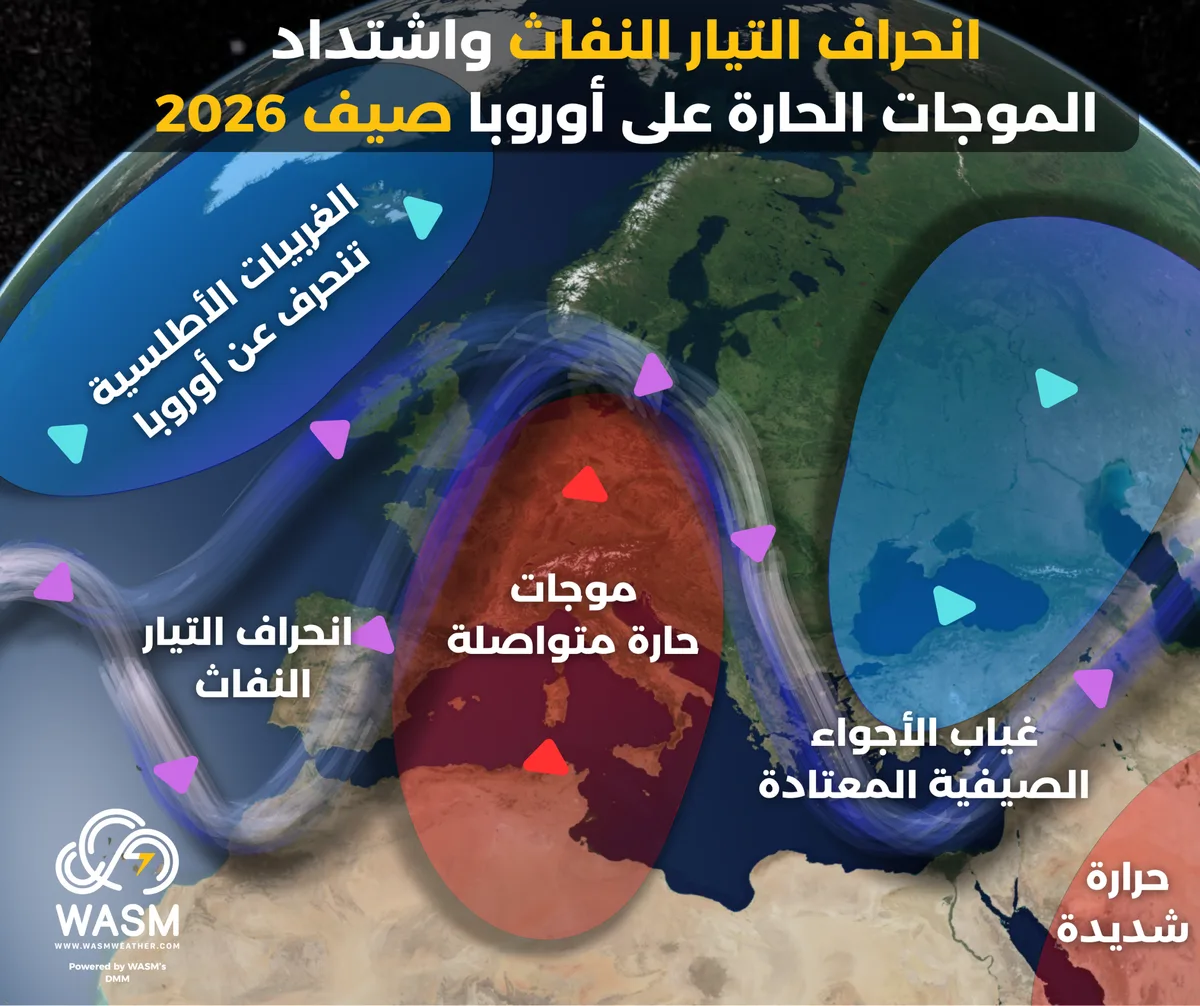
WASM- WASM Regional Center has detected a new climate phenomenon that recently appeared in the Atlantic Ocean, which is the beginning of a new deflection occurring in the jet stream flowing from the Atlantic Ocean toward Western Europe over recent weeks.
Jet streams are strong currents that blow in the upper layers of the atmosphere and are largely responsible for distributing weather systems and major atmospheric patterns, which significantly change weather and climate patterns around the world.
WASM Regional Center detected a significant weakening of the jet stream and its splitting in the western Mediterranean region over the last 5 years, but this weakening of the jet stream has intensified greatly, though with a change in its axis and position toward the eastern Atlantic Ocean and near the coasts of Western Europe, which has caused increasing disruption to the atmosphere of the eastern Mediterranean and an increase in the rate of heat waves in the European continent.
The scientific reasons behind this unusual atmospheric phenomenon are due to multiple climate factors, but there is a major and principal climate factor that has begun to emerge, which is the increasing cooling in the northern Atlantic Ocean, which exposes global warming theories and their intensification over the coming years to further scientific doubts and a lack of information about the nature of climate changes.
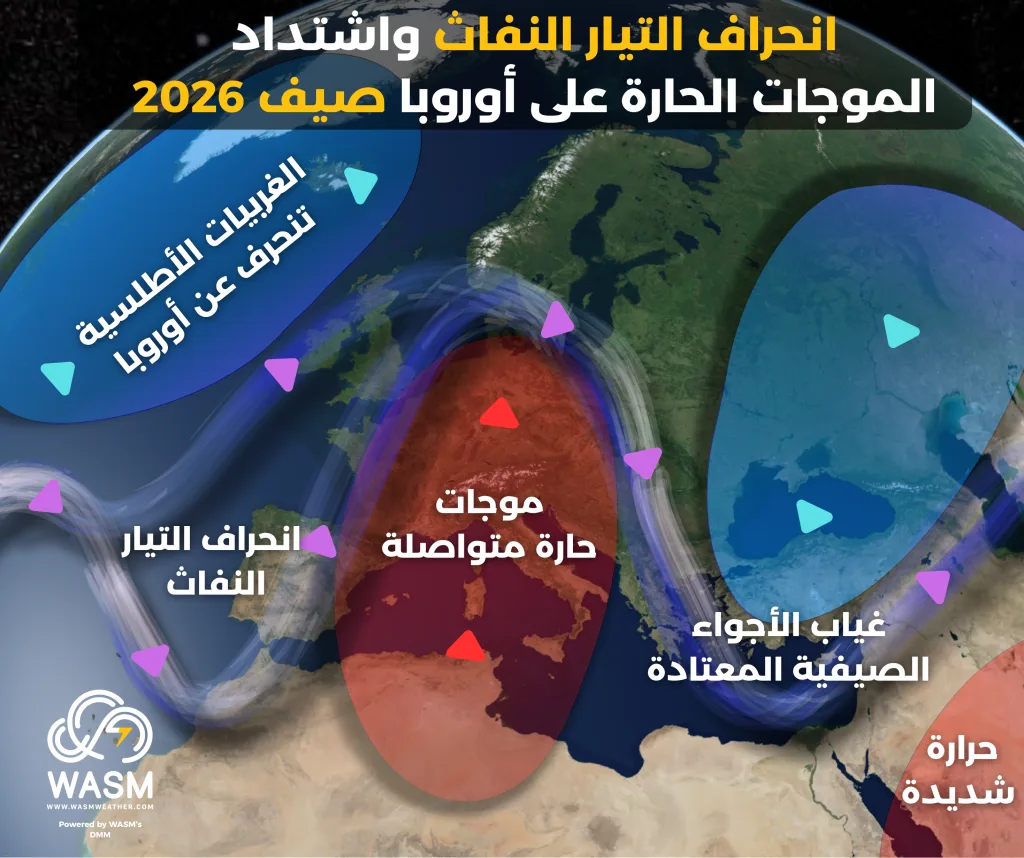
Jet Stream Deflection|
The deflection of the jet stream toward the eastern Atlantic Ocean is what caused the Atlantic westerlies to deflect away from the European continent, thus exposing the European continent to intense and continuous heat waves, which our climate studies in recent years have confirmed and how we were able to forecast the intensification of these heat waves by examining temperatures in the Atlantic Ocean.
The deflection of the jet stream toward the eastern Atlantic Ocean may be due to many climate phenomena, but the most important is the accelerating cooling in the northern Atlantic Ocean, which caused the jet stream to split and deflect westward, a change that is accelerating much more than initial expectations and an indicator of extremely serious dangers that within a few years could expose Europe to a sudden climate reversal causing its rapid cooling and causing a dangerously significant global climate change.
The deflection is due to scientific reasons related to the development of North Atlantic storms and the movement of their centers southward or the development of weaker secondary centers over the cold region of the southern Atlantic, causing the jet stream to split. These secondary centers within the Atlantic Ocean are currently causing very hot winds to push from the Sahara Desert toward Europe, with a significant decline in Atlantic westerlies and their deflection away from the North Atlantic, leading to intensification and acceleration of climate changes.
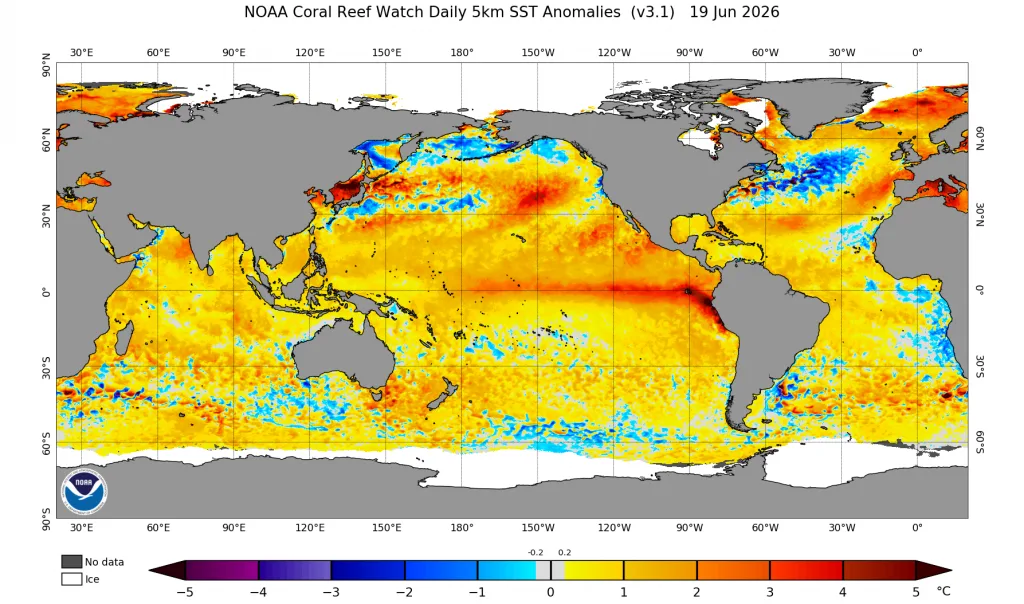
Continuous Cooling of the Northern Atlantic Ocean|
This climate phenomenon is considered the most important globally over recent months, as the cold region in the northern Atlantic Ocean has intensified. Through the statistical simulation we conducted at our center, we noticed an easier extension of the Azores high pressure system toward Western Europe during periods of cold conditions in the northern Atlantic Ocean and a significant decline in the strength of Atlantic westerlies toward Europe.
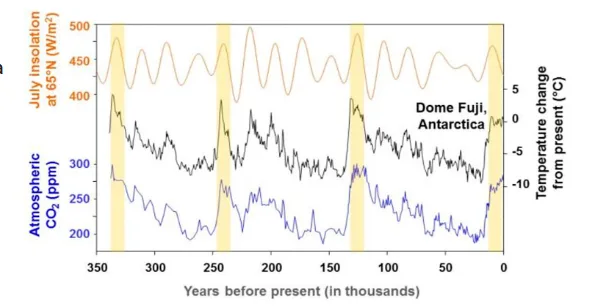
We have noted important points: cold climate cycles in the northern Atlantic Ocean that repeat every 30-35 years, and major principal climate cycles that repeat over long climate periods (possibly exceeding hundreds of years and more).
Determining this practically will be complex due to the absence of accurate climate data and the lack of expertise in the weather and climate scientist community regarding climate changes that have affected the Earth over previous millions of years, so we cannot assert this easily, but we will link it to recurring climate phenomena and then to scientific and physical factors.
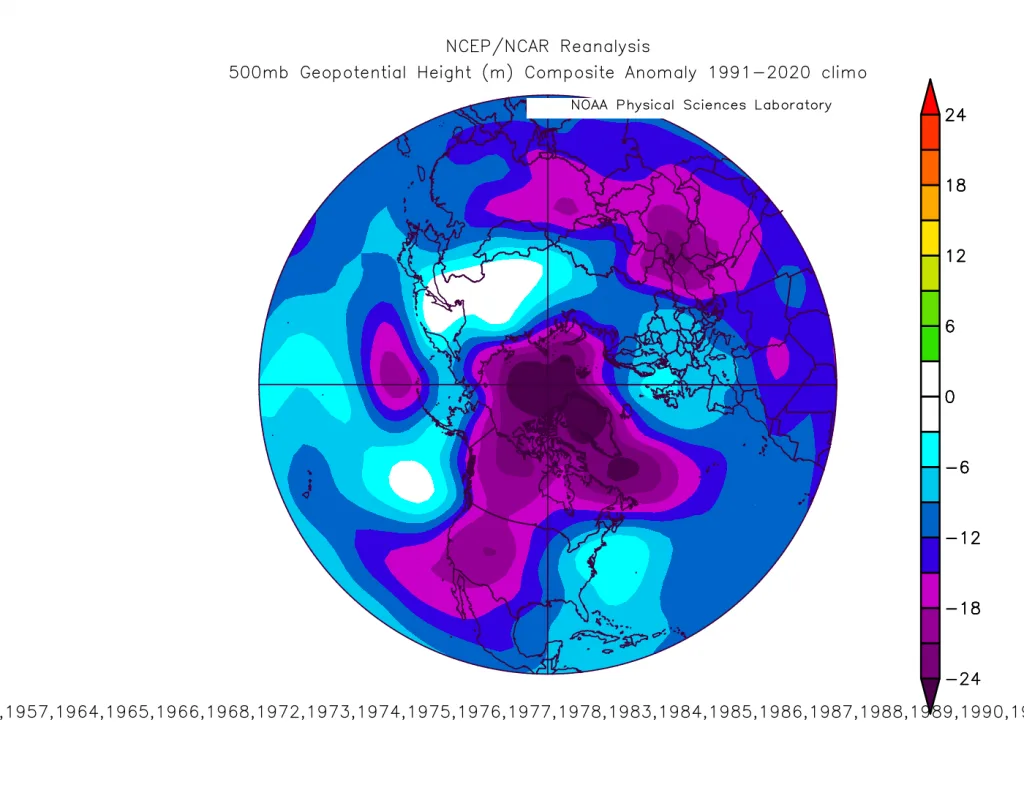
Global temperature rise is a climate phenomenon that occurs repeatedly in our global climate even before human activity and is not an exceptional phenomenon. In reality, we cannot directly link it to human activity alone without accounting for other influencing factors. There may be external and internal geological factors that increase this phenomenon or work to reverse it.
The cooling of the northern Atlantic Ocean may be an indicator of an extremely dangerous climate phenomenon that could tip the scales of climate globally, which would reverse global warming into an accelerating global cooling resulting from a disturbance in heat distribution in the Atlantic Ocean. This is a recurring matter throughout Earth's climate history and is not a new phenomenon, but the monitoring process is what we consider new, thus exposing greenhouse gas theories to increasing scientific doubts in the climate scientific community.
The strong El Niño phenomenon may lead to a very significant acceleration of climate changes and intensification of the effects of cooling in the northern Atlantic Ocean and speeding up the results on the ground.
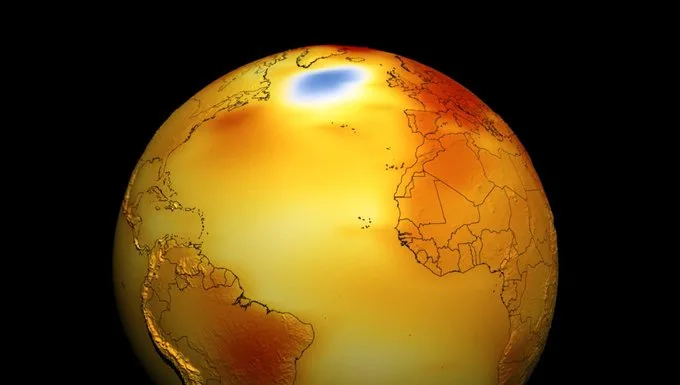
- Weakness in the Mexico Gulf Current|
The decline in the speed of the warm Mexico Gulf current has become strongly observable over recent months and has even begun to reflect the temperatures of the northern Atlantic Ocean. This current has begun to be unable to surge northward due to the reduced density of water resulting from massive melting of the ice in the northern Atlantic Ocean, which caused a disruption in water density.
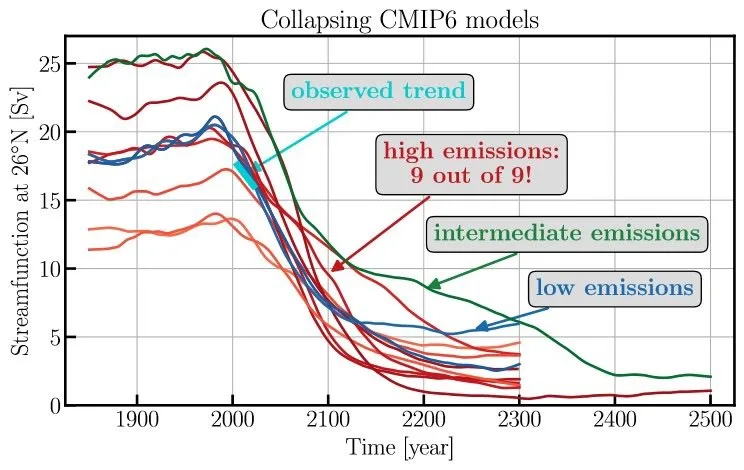
This disruption will intensify strongly over the next 5 years and in an accelerating manner and differs from the recent results issued by global climate models - CMIP6 - which predicted that this would occur in the year 2100. The results we expect may be around 2030 after statistical calibration, leading to "great" climate changes and causing a temperature drop in Europe of 7-9 degrees Celsius and possibly more due to the failure of heat transfer toward the European continent with a complete collapse of the warm Mexico Gulf current. WASM Regional Center will issue a major study on significant climate changes that will occur within a few years, supporting all the reports we have issued over the last 5 years about the reality of climate changes.
The beginning of the disruption and weakening of the warm Mexico Gulf current will lead to a significant weakening of Atlantic westerlies and an intensification of heat waves toward Europe and even the North Pole region and near Greenland. We have detected an intensification of heat waves in the European continent with their numbers multiplied more than 30 times, and the number may reach around 50 times during this summer, which will accelerate the pace of climate changes in the North Atlantic and the European continent at the same pace, making the latest mathematical equations more rigid and less dynamic regarding this climate change, or perhaps reducing the impact of this change and focusing on greenhouse gas theories instead of the nature of climate change.
The more heat waves intensify toward Western Europe and even parts of the northeastern Atlantic and its north and near Greenland, we will notice a significant acceleration in ice melting at a rate exceeding 20 times compared to the past if we take into account the doubling of heat waves in those areas, leading to a complete collapse of the warm Mexico Gulf current and an increasing deflection of the jet stream toward the Atlantic Ocean, which will pose a "real" danger to global climate (a study on this deflection coming soon).
We are facing a dangerous climate change over the coming few years. The climate scientific community must focus on the reality of climate changes rather than focusing solely on greenhouse gas effects, which could cause significant losses with the beginning of this dangerous climate change.
Sources|
https://psl.noaa.gov/cgi-bin/data/composites/printpage.pl NOAA Reanalysis_P2
CMIP6 climate model https://pcmdi.llnl.gov/CMIP6
NOAA Ocean Observatory https://www.ospo.noaa.gov/products/ocean/sst/anomaly/
Glacial-Interglacial Cycles https://www.ncei.noaa.gov/sites/default/files/2021-11/1%20Glacial-Interglacial%20Cycles-Final-OCT%202021.pdf
https://wissenschaft.de/artikel/klimawandel-raetsel-um-kalten-fleck-vertieft-sich-1781586658467