

WASM – WASM Regional Center continues to monitor the weather and climate conditions affecting different regions of the world and atmospheric circulation, while obtaining different data from the center's climate model. Results still indicate the exclusion of an expected dry rainy season in the region during 2026.
The center has studied rainy seasons since 2013, and found that the region was affected by 9 strong rainy seasons out of 12 previous rainy seasons, which raises the statistical results to 80% to predict an excellent rainy season. However, these statistical results are insufficient for seasonal forecasts, and the center developed a climate model that relies on more complex results to increase accuracy.
Atmospheric circulation will increase the chances of European continent drought|
Results continue to increase the likelihood of drought in the European continent or a notable decline in precipitation amounts during the upcoming rainy season due to increased probability of a strong high-pressure system over the continent bringing warm and dry conditions with cold and humid periods at times.
A strong high-pressure system over the western Mediterranean|
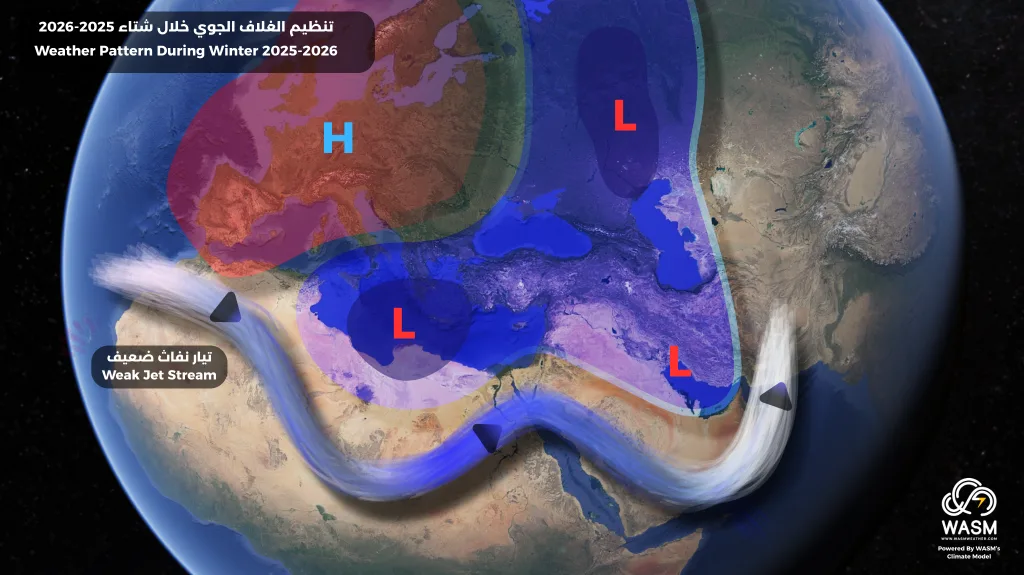
Several interconnected climate factors, especially the warming of the western Mediterranean region and its complex connection to the Atlantic Ocean, have led to forecasts of increased dominance of a strong high-pressure system over the western Mediterranean for most days of the upcoming rainy season, exposing central Mediterranean regions, especially eastern Algeria, Tunisia, Libya, southern Europe, and the Levant to rainfall conditions stronger than usual.
Linking this result to increased atmospheric pressure over the European continent increases the chances of polar waves during winter toward the central Mediterranean region in particular, as well as its eastern parts.
These conditions increase the chances of cold rainy conditions toward the Levant, Jordan, Palestine, and northern Saudi Arabia, especially during the second half of the rainy season.
Major changes over the Pacific Ocean|
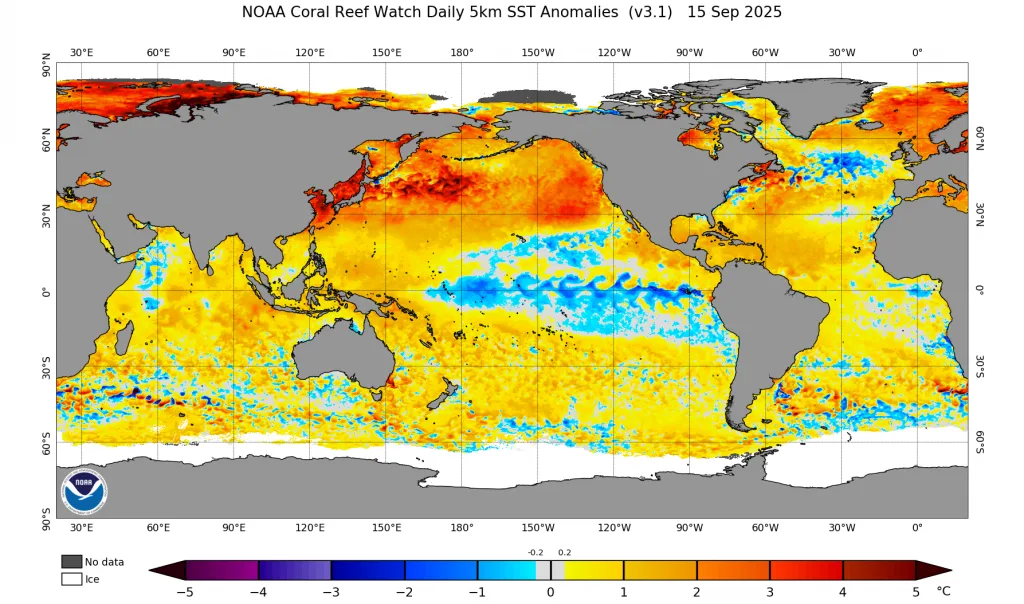
The Pacific Ocean is experiencing significant changes in temperatures, especially in its northeastern part and specifically along the coasts of the western United States, leading to a major change in the negative oscillation it experienced in the previous year (PDO). This leads to strong and direct effects on the polar jet stream and its sharp undulation, especially toward the west and central United States, as well as the central Atlantic Ocean and even its eastern parts, and also eastern European regions and the Mediterranean Sea. These results are derived from the interconnection of this factor's changes with other factors.
La Niña phenomenon still struggling|
The La Niña climate phenomenon continues to struggle with its inability to develop for the second consecutive year, and the center monitors severe oscillation in the western part of the Pacific Ocean as well as the eastern part of the Indian Ocean, which will lead to the accumulation of warm water by late autumn toward the western Pacific Ocean.
This leads to the development of the Modoki El Niño phenomenon starting from late autumn until mid-2026 gradually and supported by warm ocean waves and the warming of deep and semi-deep waters, and their cooling in the eastern part of the Pacific Ocean, which reflects strong and direct effects on the jet stream and polar undulations during the middle and end of the upcoming rainy season.
Weak jet stream over eastern and central Mediterranean|
A severe weakening is observed in the subtropical jet stream over the eastern and central Mediterranean. Although this result is negative for the northern part of the Levant, forecasts of weakening in the polar jet stream during the middle of the upcoming rainy season will increase the chances of the region being affected by a heavier than usual rainy season.
The weakening of the subtropical jet stream increases the chances of heavy rainfall in Egypt, Jordan, Palestine, Saudi Arabia, Arab Gulf countries, and Iraq. WASM Regional Center expects that the weakening of this stream is the main reason for the increase in rainfall rates in southern Levant, Saudi Arabia, Jordan, and Palestine during the last 12 rainy seasons.
Early end of summer in the Levant|
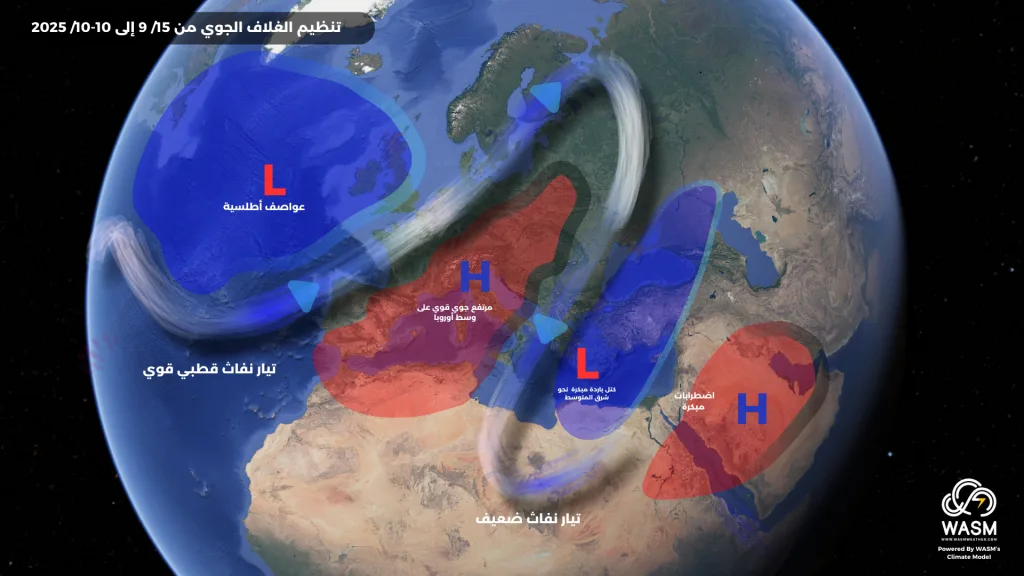
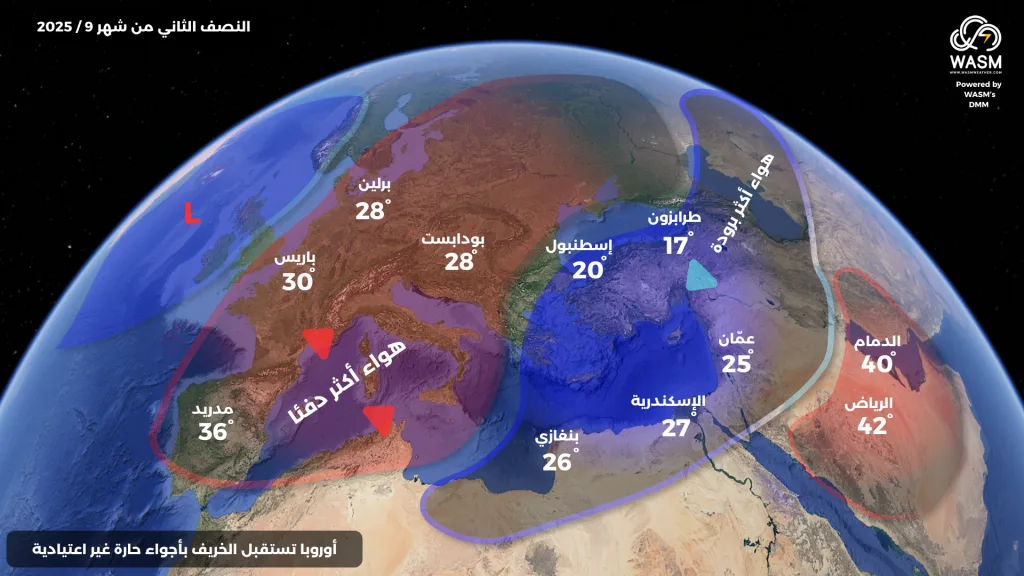
WASM Regional Center observed a "very" early end of summer, unusually compared to previous years, and this was associated with the rise in temperatures over the European continent. The end of the summer pattern was noticed since mid-August, which is considered very early.
The previous summer experienced more moderate conditions compared to previous years with the rarity of heat waves and this may also be related to climate change.
This reflects on the nature of atmospheric circulation, which increases the chances of rising atmospheric pressure over the European continent, which is considered positive for the region.
Summary of Results|
- The region is experiencing climate changes that have caused a significant increase in rainfall rates during the last 12 rainy seasons.
- Climate data is positive for the upcoming rainy season, especially during its middle and end.
- Highly volatile climate conditions in the Pacific and Atlantic oceans will lead to increased chances of drought in Europe.
- Climate factors increase the chances of polar waves toward the Mediterranean during the second half of the upcoming season.
- The main bulletin will be issued at the end of this month or the beginning of October, and it will be a regional bulletin that includes Maghreb countries.