

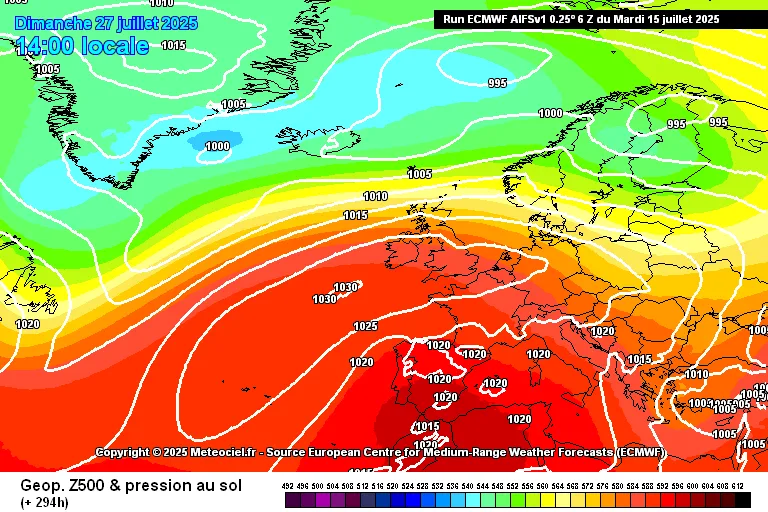
WASM – Western Europe is expected to experience more intense heat waves, particularly in Western and Central Europe, during the final days of this month and the first week of August due to unusual atmospheric circulation patterns. The number of heat waves affecting Europe this summer may be unprecedented in modern climate records, and Western Europe has experienced the historically worst start to this summer according to the Copernicus system for monitoring climate change.
Below-average temperatures in many parts of the Middle East|
Mild summer weather is expected to continue during the coming period in most areas of the Levant and Jordan, with below-average temperatures in the Arabian Peninsula, which is rare compared to this hot summer period.
Although some occasional warm periods are expected, they will remain brief with only slight increases in temperatures due to the succession of heat waves toward Europe, specifically the western regions. This weakens the chances of hot air masses pushing toward the eastern Mediterranean and penetrating toward the northwest of the Arabian Peninsula, and heat waves remain confined to eastern and southern Iraq and the northern Arabian Gulf region at intervals.
A new long period of moderation and below-average temperatures at the end of the month|
WASM Regional Center is monitoring the expected advance of an air mass that is noticeably cooler than average across eastern Europe after July 25th, which is expected to affect the eastern Mediterranean, northern Egypt, Libya, and Jordan, and arrive as below-average temperatures toward northern and central Saudi Arabia and western Iraq. These moderate air masses will coincide with the beginning of the summer rainy season in southern Arabia, which will be heavy in Yemen and the Asir and Jizan highlands through the end of this month.
Scientific causes of atmospheric circulation patterns|
WASM Regional Center is monitoring a sudden weakening of the subtropical jet stream in the western Mediterranean and eastern Atlantic Ocean due to an important climate phenomenon that has intensified since the previous summer. This weakening of the jet stream facilitates the flow of hot winds from North Africa toward the European continent, and WASM Regional Center issued a detailed scientific report explaining this changing dynamics.
The warming of the Mediterranean Sea, combined with a sudden and sharp drop in temperatures in the tropical Atlantic Ocean region, has reinforced the weakening of this jet stream, leading to intensified heat waves and an increase in their number toward the European continent.
This has easily led to the advancement of moderately warm air masses toward the eastern Mediterranean and the Arabian Peninsula, which in turn will enhance the intensification of seasonal rains toward the Asir and Jizan highlands and Yemen, as well as intensified heavy rainfall in central and southern Sudan.
The weakening of the jet stream extends across all Mediterranean areas, and WASM Regional Center has detected severe disturbances in upper-level atmospheric currents in the Middle East and Mediterranean region in recent days resulting from sharp temperature variations in the oceans and Mediterranean region.
This unusual atmospheric circulation pattern began in 2014 and intensified during the period from 2015 to 2024, resulting in a significant increase in rainfall rates by 40-60% in western and northern Saudi Arabia, Jordan, Palestine, northeastern Egypt, and large areas of the Arabian Gulf, with a notable intensification of these changes in recent years, indicating more powerful and distinct climate changes during the coming period.